How to Cook Raw Chinese Herbs at Home (Step-by-Step Decoction Guide)
So your practitioner sent you home with a brown paper bag of twigs, bark, roots, and what looks suspiciously like a dried mushroom. You're now wondering what on earth to do with it.
This is your guide to cooking raw Chinese herbs (called a decoction) at home, simply, safely, and without setting off the smoke alarm.
If you're taking pills or granules instead, see Tips for Taking Chinese Herbs for that version.
Quick answer
A Chinese herbal decoction is a strong tea made from raw plant parts. Soak the herbs in 3.5 cups of cool water for 20 to 30 minutes, simmer for 30 to 40 minutes, strain off the liquid, then simmer the same herbs again with 2.5 cups of fresh water. Combine both batches (about 2 cups total). For chronic conditions, divide by 4 and drink morning and evening for 2 days. For acute conditions, divide by 2 and drink morning and evening on the same day.
What is a Chinese Herbal Decoction?
A decoction is just a strong tea made from raw plant parts. You soak, simmer, strain, and drink. The water pulls the active compounds out of the herbs and leaves you with a concentrated brew tailored to your body.
Raw herbs are the original form of Chinese herbal medicine. Stronger than pills, more flexible than granules, and (after the first sip) actually quite manageable.
What You'll Need
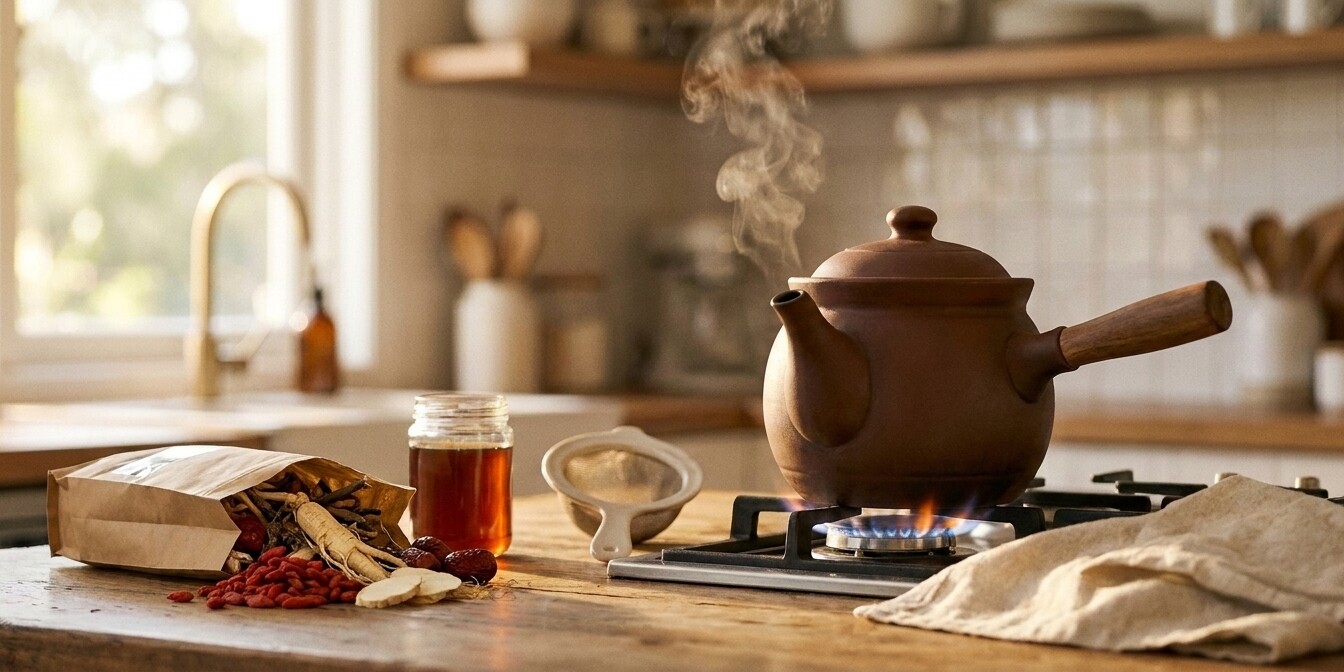
- A pot. Glass, ceramic, clay, or stainless steel. Avoid aluminium, copper, cast iron, or anything with a non-stick coating, the metals can react with the herbs.
- Filtered water. Tap water is fine if your area has decent water, but filtered is better.
- A strainer or cheesecloth. Something fine enough to catch small bits.
- A jug or two glass jars. For storing the finished decoction.
- Your bag of herbs. Usually pre-divided into single-day portions.
A dedicated clay herb cooker is traditional and excellent if you take herbs often, but absolutely not required. A regular saucepan is fine.
How Long One Packet Lasts (Read This First)
Most online guides assume one packet equals one day. In my clinic, that's only true for acute conditions, things like fever, sharp pain, or a flare-up that needs full-strength dosing. For most ongoing treatments, the dosing is gentler and a single packet covers two days.
Here's the breakdown:
- Chronic conditions (default): 1 packet = 2 days. Cook once, drink across 4 doses.
- Busy adaptation: 2 packets cooked back to back = 4 days. Same idea, less cooking.
- Acute conditions: 1 packet = 1 day. Stronger, more frequent dosing. Your practitioner will tell you if this applies.
Always follow what your practitioner has prescribed. If you're not sure which version applies to you, ask before you start.
Step-by-Step: How to Cook Raw Herbs
This is the standard method. It works the same whether you're on the chronic or acute schedule, the only difference is how you split the finished decoction.
1. Open one packet
Each packet is one cooking session. Don't combine packets in the same pot, even if you're cooking two days at once.
2. Soak the herbs
Tip the packet into your pot. Add 3.5 cups (about 875ml) of cool water, enough to cover the herbs by 2 to 3cm. If the herbs are bulky and need more water to cover, add a bit more, that's fine. Let them soak for 20 to 30 minutes. This softens the plant material and helps the active compounds release properly. Skipping the soak gives you a weaker brew.
3. First simmer
Bring to a boil with the lid on, then drop to a low simmer for 30 to 40 minutes. Lid stays on, but slightly cracked so steam can escape. Check occasionally that there's still water in the pot.
⏰ Set a timer. Always. The simmer is gentle and quiet, easy to forget. Come back to a dry pot and you've burnt a week's worth of herbs into the bottom of your saucepan. The smoke alarm will let you know.
4. Strain off the first batch
Pour the liquid through your strainer into a jug. Keep the herbs in the pot.
5. Second simmer
Add 2.5 cups (about 625ml) of fresh water to the same herbs. Simmer again for 20 to 30 minutes. Strain into the same jug.
6. Combine and measure
Mix both batches together. You should end up with about 2 cups (500ml) of finished decoction, give or take depending on how much water you started with. Don't worry about the exact volume, just measure the total and divide it.
How to Split Your Decoction
Take whatever total volume you ended up with and divide it by the number of doses needed:
Chronic conditions (default): 1 packet = 2 days
- Divide your total volume by 4.
- Drink one quarter in the morning and one quarter in the evening, for two days.
- If you finished with 2 cups, that's about ½ cup per dose.
Acute conditions: 1 packet = 1 day
- Divide your total volume by 2.
- Drink half in the morning and half in the evening, on the same day.
- If you finished with 2 cups, that's 1 cup per dose.
Stick with whatever your practitioner prescribed. The dosing reflects the strength your body needs.
When to Take Your Decoction
- 30 minutes before food, or 1 hour after, for best absorption.
- Drink it warm, not hot, not cold.
- Morning and evening, ideally about 12 hours apart.
- If your practitioner gave different instructions, follow theirs.
How to Drink It (Without Pulling a Face)
The taste is part of the medicine. Bitter, earthy, occasionally swampy. Some formulas are easier than others.
Things that help:
- Drink it like a small cup of tea, not a shot. Sipping gives your tongue less to react to.
- Hold your nose for the first few sips if needed.
- Chase with a small piece of date or candied ginger. Don't add sugar or honey unless approved, some formulas are less effective with sweeteners.
- Brush your teeth after if the taste lingers.
You'll get used to it within a few days. Most people end up tolerating it fine.
Special Instructions Your Practitioner Might Add
Some herbs need different handling. If your practitioner mentions any of these, follow their lead:
- Decoct first: Certain herbs (like mineral or shell-based herbs) need 20 to 30 minutes of cooking *before* the rest go in.
- Add later: Aromatic herbs (like mint or perilla) lose their potency if cooked too long. Add them in the last 5 to 10 minutes only.
- Wrap in cloth: Some herbs are floaty or fluffy and get wrapped in muslin so they don't end up in your cup.
- Dissolve separately: Things like gelatin (e jiao) get warmed and stirred in at the end.
If your packet has separate small bags inside the main bag, those are usually the special-handling herbs. Ask if you're not sure.
How to Store Your Decoction
- Same day: Keep at room temperature in a covered jar. Drink within 12 hours.
- 1 to 4 days: Refrigerate in glass jars. Warm gently before drinking. Use within 4 days of cooking.
- Don't microwave if you can avoid it. Warm on the stove, in a hot water bath, or in a thermos. Microwave is fine in a pinch.
- Don't reuse the cooked herbs after the second simmer. Compost them.
What to Expect
- The smell will fill your kitchen. Open a window. It fades within an hour.
- Your urine might smell or look different. That's normal.
- Some people feel changes within days, others take weeks. Both are normal.
- If you notice anything unexpected (rash, digestive upset, wired feeling), pause and message your practitioner.
Common Mistakes to Avoid
- Using a metal pot that reacts. Stick to glass, ceramic, clay, or stainless steel.
- Skipping the soak. Big difference in potency.
- Boiling too hard. A gentle simmer extracts the medicine. A rolling boil destroys it.
- Lifting the lid constantly. Lets the volatile compounds escape.
- Drinking it cold. Cold decoctions are harder on digestion and less effective.
- Combining packets to save time. Each packet is a day's dose. Doubling up doesn't double the benefit, it just wastes herbs.
Cooking Two Packets at Once: 4 Days of Herbs in One Session
For single parents and busy professionals, this is the version that actually fits real life. Cook two packets back to back, divide the volume across four days, get on with your week.
How to do it
- Cook two packets back to back on the same evening. Use the standard method (soak, simmer, strain, second simmer, combine) for each packet separately. Don't combine the herbs in one pot, each packet needs its own cooking water and timing.
- Combine both finished batches into one jug. You should end up with around 4 cups (1 litre) total.
- Divide the total by 8 to get your dose. That's about ½ cup per dose, taken morning and evening for 4 days.
- Pre-portion into 8 small glass jars or one labelled jug with marked dose lines. Refrigerate.
- Each day: warm a portion gently, drink within 5 to 10 minutes.
Tips that make this actually work
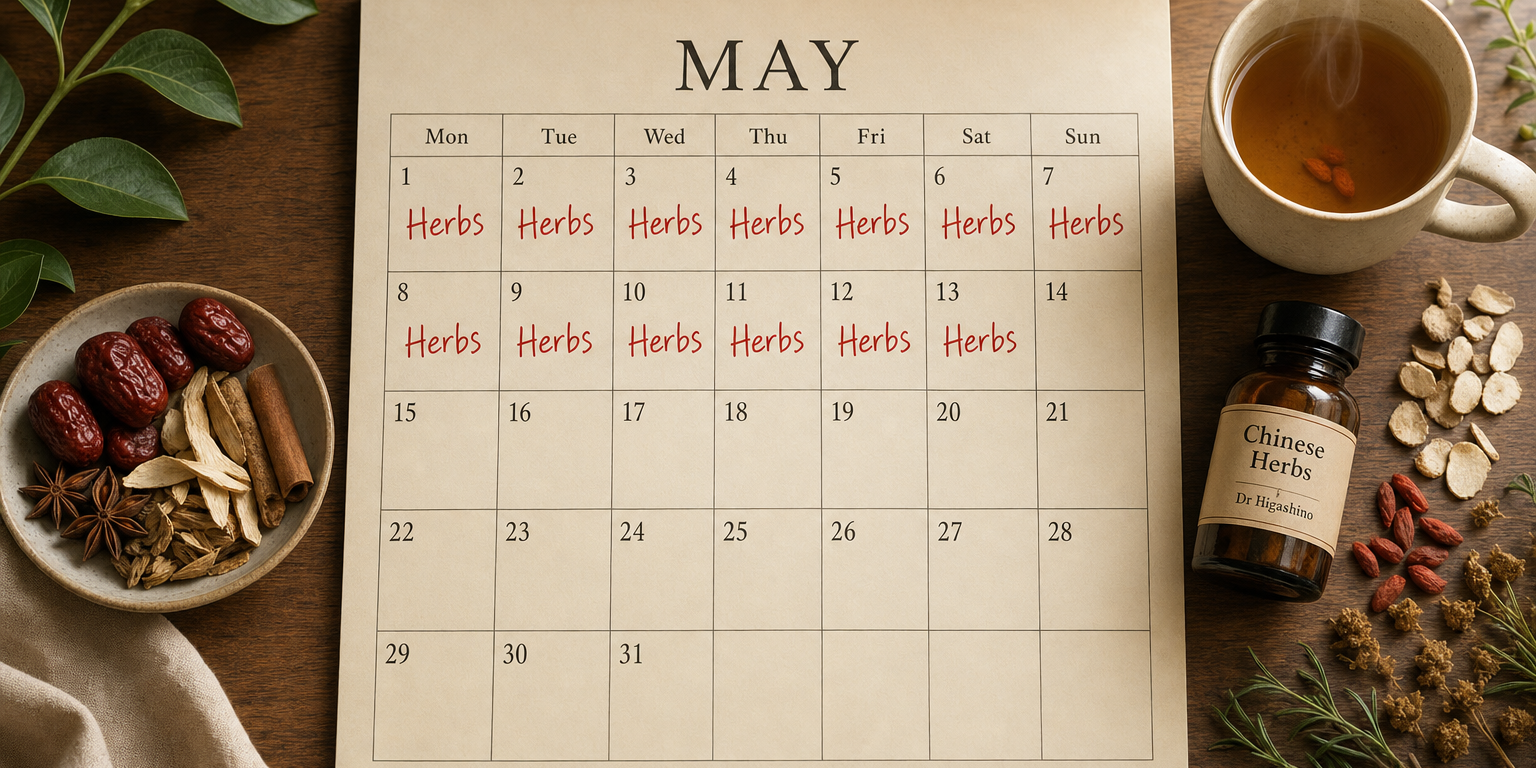
- Cook on Sundays. One cooking session per week covers Monday through Thursday. Repeat midweek for Friday through Monday, or skip ahead with granules on weekends.
- Cook while you do something else, but SET A TIMER. The simmer is unattended, fold laundry, help with homework, eat dinner. But seriously, set a timer. Forget about it for an hour and you'll come back to a smoky kitchen, a dry pot, and a small pile of very expensive charcoal. Phone alarm labelled "HERBS" is your friend.
- Use small mason jars (200 to 250ml). Pre-portioned doses you can grab from the fridge.
- Warm in a thermos for work. Pour the morning dose into a small thermos before you leave. It stays warm for hours.
What you lose by doing this
About 10 to 20% of the medicinal strength compared to drinking it the same day, mostly from volatile aromatic compounds. For most chronic conditions this is a fair trade for the consistency. For acute presentations (fever, infection, sharp pain), fresh wins, cook daily if you can.
What not to do
- Don't stretch the schedule beyond 4 days. Past that, the decoction loses potency and can spoil.
- Don't freeze unless your practitioner specifically says it's okay for your formula.
- Don't combine the raw herbs from both packets into one giant pot. Each packet cooks separately, then you combine the liquid.
- Don't store in plastic. Glass jars only.
If you're considering this, mention it to your practitioner. They might suggest granules instead, which are designed for exactly this kind of busy life and skip the cooking entirely.
Why Bother With Raw Herbs Instead of Pills?
Raw herbs are the most powerful form of Chinese medicine. They're tailored to your exact pattern, can be adjusted week by week, and the act of preparing them is part of the medicine. You connect with the process.
That said, they're a commitment. If your schedule doesn't allow daily cooking, ask your practitioner about granules or pills as alternatives.
Want Help With Your Formula?
If you've been prescribed raw herbs and you're not sure how to handle yours specifically, or you want to check whether your formula is still the right fit, book a follow-up or message me. The first cook is always the hardest. After that, it's just part of your routine.
If you want a deeper understanding of how Chinese medicine works (and how to get the most out of treatment), I'm writing a book called Before the Needles. Sign up for early access and get a free chapter when it's ready.
Frequently Asked Questions
How long does it take to cook raw Chinese herbs?
Soak for 20 to 30 minutes, then simmer for 30 to 40 minutes for the first batch and 20 to 30 minutes for the second. Total active time is around 90 minutes, but most of that is unattended.
Can I use a slow cooker or Instant Pot?
Yes for an Instant Pot (use the slow cook or sauté/simmer function, not pressure). Slow cookers can work but don't get hot enough on low, use the high setting and check the temperature reaches a true simmer. A regular pot on the stove is still the most reliable.
How long do raw herbs last?
Dry, sealed, in a cool dark place: usually 2 to 3 months. Once cooked, drink within 48 hours and keep refrigerated.
Can I use a microwave to reheat my herbs?
Yes, a quick gentle reheat in the microwave is fine, the stove or a hot water bath is preferred but the microwave won't ruin your formula. Just don't let it come to a rolling boil again once it's been prepared, you're warming it, not re-cooking it.
Can I cook all my packets at once and freeze them?
Freezing isn't recommended, the medicine works best fresh or refrigerated. But cooking 2 packets at once for 4 days of doses is a solid adaptation if you can't cook midweek. See the section above for the method.
Do I have to drink it all in one go?
No. Sip it like tea over 5 to 10 minutes. Splitting into smaller portions across the morning is also fine if your stomach is sensitive.
What if I miss a dose?
Take the next dose at the normal time. Don't double up. Consistency matters more than perfection.
About the author
Eric Higashino is a registered Chinese medicine practitioner (AHPRA) and acupuncturist based in Ballina, NSW, Australia. He treats chronic and complex conditions including Gu Syndrome, mould-related illness, MCAS, POTS and digestive disorders using Chinese herbal medicine, acupuncture and moxibustion. Read more about Eric or book a session.
Gu Syndrome for Mould, Ticks & Complex Chronic Illness
If you’ve done the tests, tried the protocols, changed the diet, bought the supplements… and you still don’t feel like yourself, this page is for you.
Gu Syndrome is a classical Chinese medicine pattern lens for cases that are stubborn, multi-system, and prone to relapse, often seen in people dealing with mould exposure / CIRS-style illness, tick-borne illness patterns, chronic fatigue, and other “nothing fits neatly” chronic conditions.
What we do here: we build a clear plan to reduce reactivity, restore capacity, and move you forward step-by-step, without throwing the kitchen sink at you.
If You’ve Tried Everything and Still Feel Stuck
This isn’t about being “weak” or “not trying hard enough.” Complex chronic illness can behave like a smouldering fire behind a wall, it’s not always obvious where it’s coming from, but it keeps flaring up in different rooms of the house.
This commonly looks like…
-
Fatigue that isn’t fixed by rest
-
Brain fog, “wired but tired,” poor sleep
-
Gut issues (bloating, food reactions, nausea, unstable appetite)
-
Sensitivities (smells, mouldy buildings, foods, supplements)
-
Symptoms that move around or change week to week
-
Big setbacks from small stressors (a virus, travel, a busy week)
-
You’ve had some improvements… but they don’t hold
The cases we most often see under this umbrella
-
Mould exposure / CIRS-style illness presentations
-
Tick-borne illness labels or suspicion
-
Chronic fatigue / post-viral / long recovery states
-
Multi-system chronic inflammation patterns (gut, skin, sinus, neuro overlap)
If you’re looking for a one-visit quick fix, this is probably not the right fit.
If you want a structured plan and someone used to complex cases, keep going.
The Gu Case Plan (How We Work With Complex Chronic Cases)
Most people with complex chronic illness fail for one of two reasons:
-
They never get a clear model of what’s actually driving the pattern, or
-
They try to “kill the problem” before their system has the capacity to handle it.
We do the opposite: stabilise first, then create an internal environment that doesn't allow the disease to re-establish.
Step 1, Stabilise & reduce reactivity
Before we push anything, we focus on fundamentals that help your system stop overreacting:
-
regulation, sleep, digestion, stress-load
-
calming “flare mechanics” so you’re not constantly sliding backwards
Step 2, Identify your main pattern drivers
This is where Chinese medicine pattern differentiation shines. We map:
-
what’s primary vs secondary
-
what’s maintaining the loop
-
what needs to be addressed now vs later
Step 3, Layer-by-layer strategy (not kitchen-sink protocols)
Complex cases respond best to sequencing:
-
one clear phase at a time
-
adjust based on feedback
-
avoid the “too much too soon” crash cycle
Step 4, Consolidate gains & prevent relapse
The finish line isn’t “a good week.” It’s:
-
more stable energy
-
fewer flare-ups
-
better resilience under normal life stressors
What you’ll leave the first consult with
-
A clear working model of your pattern (in plain English)
-
A phased plan: what we’re doing now vs later
-
What to start / stop (to reduce noise and reactions)
-
Simple progress markers to track (so it’s not guesswork)
-
Recommended treatment frequency for the first phase
If you want a plan that actually makes sense for a complex case: Book an Initial Consultation
What Gu Syndrome Means (Plain English)
Gu Syndrome isn’t a single disease, and it isn’t a trendy label.
It’s a classical Chinese medicine pattern used to describe a certain type of chronic illness picture: symptoms that are persistent, complicated, and hard to shift, often with a sense that something is “stuck in the system”.
The simplest way to understand it
Think of your health like a house.
Most illnesses are like a broken window: obvious cause, obvious fix, clear timeline.
Gu-pattern illness is more like a smouldering issue behind the walls. You might repaint the room (diet/supplements), replace furniture (new protocols), even change houses (new practitioners)… but the smoke keeps coming back because the underlying pattern hasn’t been addressed properly.
The “hidden driver” problem
In Gu-type cases, the system can get caught in a loop:
-
your resilience drops
-
your gut/immune/nervous system becomes more reactive
-
you become sensitive to triggers (foods, smells, environments, stress)
-
flare-ups become easier to trigger and harder to recover from
This is why people often say: “I can’t tolerate anything,” or “Every time I try a treatment, I crash.”
What Gu is, and what it isn’t
Gu is:
-
a way to make sense of complex, multi-system patterns
-
a guide for sequencing treatment so you can actually tolerate it
-
a clinical framework for “stuck” cases that relapse
Gu is not:
-
a promise of a quick fix
-
a replacement for medical diagnosis
-
“just parasites” (sometimes relevant, sometimes not)
-
something we treat with one magic herb or protocol
What Treatment May Involve
Because Gu cases vary a lot, treatment isn’t a cookie-cutter protocol. It’s a tailored plan with clear phases.
Acupuncture (regulation + recovery support)
In complex chronic illness, the nervous system often behaves like it’s stuck in high alert. Acupuncture can help shift the system toward:
-
better sleep quality
-
improved stress tolerance
-
reduced flare intensity
-
steadier digestion and energy regulation
(Translation: it helps you get traction again.)
Chinese herbal medicine (tailored formulas)
Herbs are prescribed based on your pattern; your constitution, symptom picture, and sensitivity level.
Depending on your presentation and phase of care, herbal strategies may focus on things like:
-
supporting digestion and “terrain”
-
helping the body process and clear what it’s struggling to move
-
strengthening resilience so you don’t keep relapsing
-
calming the reactivity loop
Important: in highly sensitive patients, we start low and build carefully. The goal is progress you can hold, not reactions you have to recover from.
Food + lifestyle (only what actually matters)
This is not about perfection. It’s about removing the few key “fuel sources” that keep the fire burning, and adding the few key levers that restore capacity.
You’ll get:
-
practical food guidance (not a new religion)
-
pacing strategies for fatigue/crashes
-
sleep support that fits real life
-
environmental considerations where relevant (especially mould exposure)
What Progress Usually Looks Like (Honest Timeline)
Most people with complex chronic illness don’t need more hype. They need predictability.
Progress in Gu cases is often non-linear, especially early on. The aim is to reduce volatility first, then build upward.
Early phase (stability first)
Often the first improvements are things like:
-
fewer extreme dips
-
slightly better sleep
-
calmer digestion
-
less “wired but tired”
-
better recovery after a busy day
Middle phase (capacity builds)
This is where you may notice:
-
steadier baseline energy
-
fewer and shorter flare-ups
-
less reactivity to foods/environments
-
clearer thinking and mood stability
Later phase (resilience and relapse prevention)
The longer-term goal:
-
you can handle normal life stress without crashing
-
symptoms don’t run the show
-
you have a maintenance plan that’s realistic
Key point: We don’t chase perfection. We chase durable improvement.
What to Expect as a New Patient
Your initial consultation
We’ll cover:
-
your full timeline (what changed, when, and what’s kept it going)
-
your current symptom clusters and triggers
-
what you’ve tried and how you responded
-
sensitivities and tolerance level (so we don’t overdo it)
Your plan and next steps
You’ll leave with:
-
a clear phased strategy
-
an initial treatment plan (acupuncture + herbs if appropriate)
-
what to track so we can adjust intelligently
Telehealth vs in-clinic
-
In-clinic is ideal when acupuncture is a key part of your plan.
-
Telehealth can work well for complex chronic cases when the focus is herbs, pacing, food/lifestyle strategy, and ongoing plan refinement.
FAQs (The Questions People Actually Ask)
“I’ve tried everything, how is this different?”
Most approaches fail complex cases by going too hard too soon, or by treating one layer as if it’s the whole picture. We focus on sequencing, tolerance, and building capacity so progress holds.
“I’m very sensitive. What if I react to everything?”
Then we go slower. Sensitivity isn’t a character flaw, it’s data. The plan is built around what you can tolerate, not what looks impressive on paper.
“Do I need tests before I book?”
Not necessarily. Bring any results you already have. We can also suggest what might be useful to discuss with your GP if relevant.
“How many sessions will I need?”
It depends on duration, severity, and sensitivity. Most complex cases do best with a phase-based plan and regular review, rather than a fixed number up front.
“Can I use herbs with medications?”
Often yes, but it needs care. We screen interactions and adjust dosage and timing appropriately. If you’re on multiple medications, tell us everything you’re taking.
Book a Consultation
If you’re dealing with mould exposure/CIRS-style illness, tick-borne patterns, chronic fatigue, or a complex mix of symptoms that hasn’t shifted, this is exactly the kind of case we’re set up to handle.
Tips for Taking Chinese Herbs: How to Make It Easy, Effective, and Part of Your Routine
If you're new to Chinese herbs, you're not alone in wondering things like: "Do I take these with food?" or "How am I supposed to remember three times a day?"
This guide is here to help. Whether you're taking patent pills or granules, there are simple ways to build them into your routine so they actually do what they're meant to, support your healing. And no, you don’t need to be perfect to see results. In Chinese medicine, consistency matters more than perfection. Let’s make this simple and doable.
Quick answer
Take your Chinese herbs 30 minutes before food or 1 hour after eating, with warm water. For patent pills, swallow the prescribed number whole. For granules, dissolve 1 teaspoon in 100 to 150ml of warm water and drink like tea. Take consistently, ideally 2 to 3 times a day. Consistency matters more than perfect timing, even imperfect dosing beats skipping.
Where should I get Chinese herbs?
It's best to get your Chinese herbs from a qualified practitioner who can properly diagnose your TCM pattern and match the right formula to your body. Herbal formulas are powerful when used correctly, but not all herbs are suitable for all bodies. You might find herbs online or at health stores, but without a full understanding of the formula, you might not get the results you want, or worse, you could aggravate your symptoms.
If you are prescribed raw herbs (the kind you cook at home), check out my guide on How to Cook Raw Chinese Herbs for extra tips.
What are the main forms of Chinese herbs?
Patent Pills:
- Small, round, easy to swallow.
- Great for travel and busy schedules.
- Best for when your formula stays consistent over time.
Granules:
- Powdered extract form.
- Dissolve easily in warm water
- Easier to adjust dosage depending on how you’re responding.
Taste Tip: Sensitive to tastes? Pills are usually easier. Want a stronger, faster effect? Granules are often more potent.
When should I take my Chinese herbs?
Ideally, take your herbs 30 minutes before meals or 1 hour after eating. This timing helps your body absorb the herbs without the interference of digestion.
BUT: It’s far more important to actually take your herbs consistently, even if the timing isn’t perfect.
If you forget and it’s mealtime? Take them anyway. Your body benefits more from steady support than from occasional "perfect timing."
How can I remember to take my herbs?

- Visual reminders: Leave your herbs next to your toothbrush, kettle, or coffee machine.
- Phone alarms: Set recurring reminders labeled “herbs.”
- Habit stacking: Link it to a habit you already have. Example: "I brush my teeth → I take my herbs."
- Portable options: If you’re using pills, keep a small bottle in your bag or car.
- Weekly organizer: Especially helpful if you have multiple formulas or a busy schedule.
Pro tip: Treat it like brushing your teeth, not dramatic, just part of daily care.
Get early access (and a discount) to Before the Needles. Sign up free →
How do I take Chinese herbs?
Patent Pills:
- Simply swallow the prescribed number of pills with water
- Try to avoid chewing as the taste can be strong
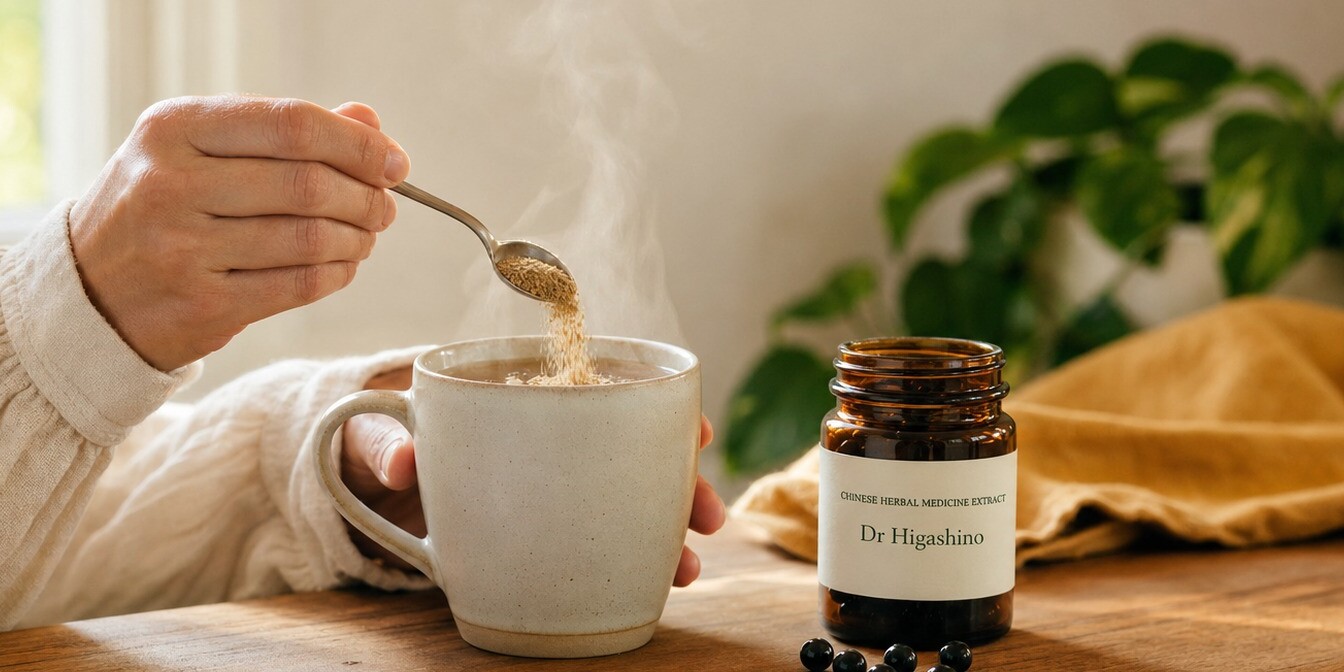
Granules:
- Measure the prescribed dose
- Typically for an adult, 1 teaspoon 3 times a day or 1.5 teaspoons 2 times a day
- Dissolve the granules in about 100-150ml of warm water (about ½ to ⅔ cup)
- Stir until fully dissolved
- Drink it like tea
What if I can't stand the taste of granules?
If the taste of granules feels overwhelming, you're not alone. Here are a few easy tricks to make them more manageable:
- Chase it technique: Instead of mixing it, place the dry powder on your tongue, then quickly wash it down with warm water.
- Dilute more: Use a larger cup of warm water to spread out the flavor.
- Mix with something pleasant: Add a splash of warm apple juice or a little honey after dissolving the herbs.
- Use a straw: Sip the liquid with a straw to bypass most of your taste buds.
- Chase it: Drink the granules quickly, then follow immediately with a sip of tea, water, or juice.
- Temperature matters: Make sure the water is warm but not too hot, as extremely hot water can intensify the bitterness.
Remember: the flavor is part of the medicine, but it's absolutely okay to make it easier on yourself!
What should I expect (taste, texture, timing)?
Granules:
- Earthy, slightly bitter taste is normal.
- Mix with warm water, add a splash of honey or warm apple juice if needed.
- Drink it like tea, not all at once like a shot.
Pills:
- Swallow with water.
- Don’t chew them (trust me on this one).
Timing expectations:
- Some people notice changes quickly; others feel a slow, steady improvement.
- Trust the process. Your body is working with the herbs, not just being "forced" to change.
Why does consistency matter with Chinese herbs?
Chinese medicine is about supporting your body’s natural rhythms. It’s like watering a plant: a little, regularly, is far better than dumping a bucket once a week.
Taking your herbs consistently helps your body gently shift back into balance. This matters even more if you're working through a damp pattern or chronic condition. Skipping doses interrupts that support. Even imperfect dosing, as long as it’s steady, is better than aiming for perfection and doing nothing.
Herbs work on the deep ecosystems of your body. They're not a "band-aid"; they're helping rebuild the soil, not just trimming the weeds.
Want to get the most out of your herbs?
If you have herbs at home and you're not sure how to take them, or your formula is part of treatment for a complex condition like Gu Syndrome, or you want to make sure your current formula is still the best fit, I’m here to help.
Book a follow-up or send me a message. Your body deserves consistent support, and you deserve to feel your best.
About the author
Eric Higashino is a registered Chinese medicine practitioner (AHPRA) and acupuncturist based in Ballina, NSW, Australia. He treats chronic and complex conditions including Gu Syndrome, mould-related illness, MCAS, POTS and digestive disorders using Chinese herbal medicine, acupuncture and moxibustion. Read more about Eric or book a session.
What to read next