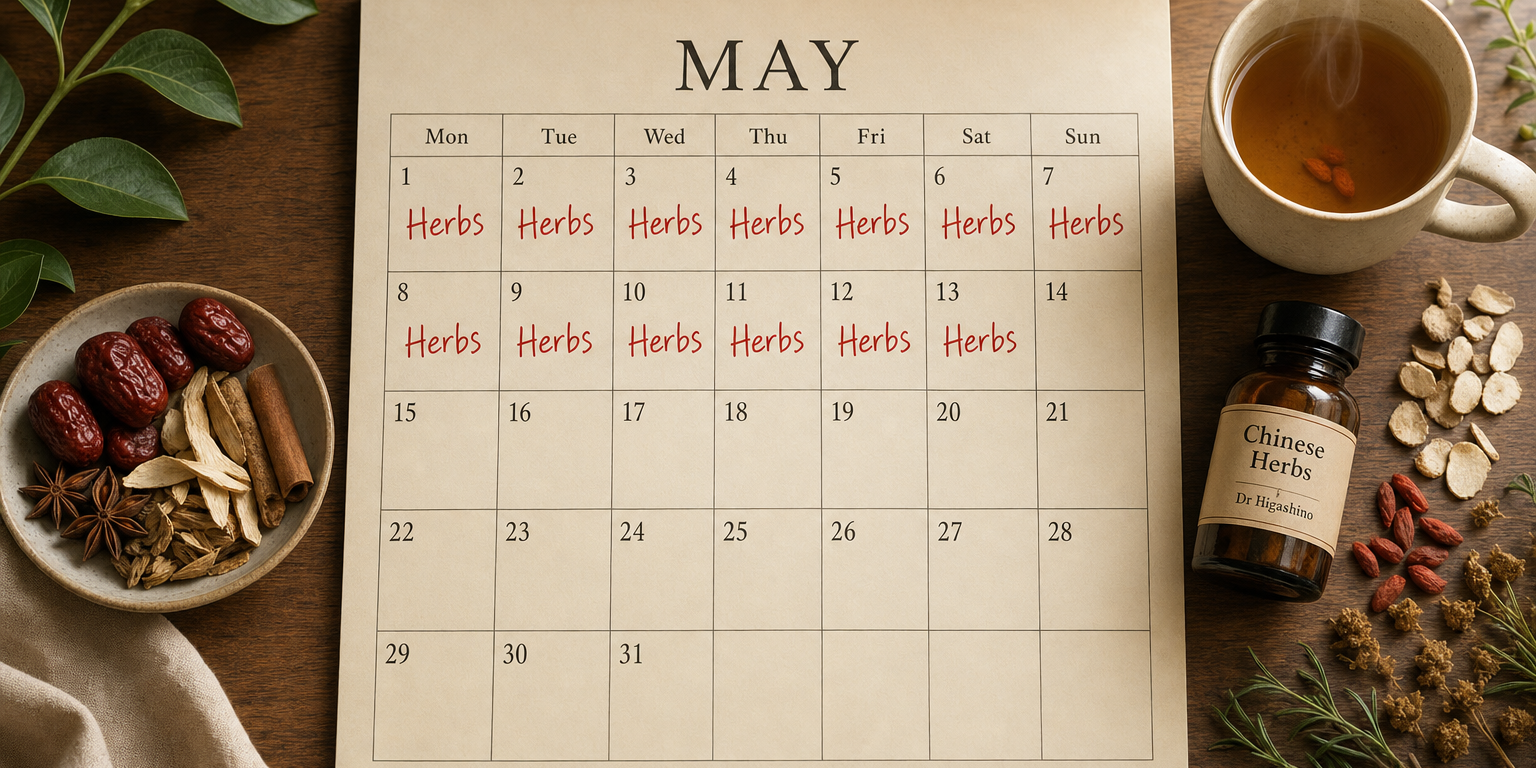
Top-down widescreen flat-lay of a May paper calendar with 'Herbs' written in red on days 1-13, beside a steaming mug of Chinese herbal tea, an apothecary bottle, jujubes and dried roots on warm wood.

How Long Do Chinese Herbs Take to Work?

One of my patients, who I'll call Lisa, had been taking her formula for one week.

She texted me on a Tuesday: "I'm not really noticing anything yet. Should I keep going?"

I hear this constantly. A week feels like long enough. You've been consistent, you've been drinking the bitter tea, you haven't missed a dose. And your main complaint hasn't changed.

But here's what I've learned from years of prescribing Chinese herbs: it depends on how chronic the condition is and how deep the condition is.

When treating something acute, you should expect something in hours to a week. When something chronic or deeply entrenched you should still see changes quickly, but it may not be the main thing you came in for. Maybe you notice that your sleep deepens, digestion settles, you notice mid-afternoon that you're not reaching for coffee, or your period starts without the usual warning shots of pain.

The question isn't just "how long do Chinese herbs take to work?" It's "what does working actually look like for the type of condition I have?"


Quick answer

Chinese herbs work on four timelines. Acute conditions (cold, flu, acute pain) respond within hours to one week. Functional complaints (digestion, sleep, energy) begin shifting in two to four weeks. Chronic conditions (eczema, IBS, chronic fatigue) need six to twelve weeks. Deeply rooted conditions require three to six months or longer. Progress often shows in sleep, digestion, and energy before the chief complaint shifts.


The four timelines: what to expect at each stage

The timeline depends almost entirely on what the herbs are treating, how deep the pattern sits, and how long it's been there.

Here is a practical map:

Line-art illustration of four people representing the four levels of condition depth in Chinese medicine: an acute cold/flu (hours to 1 week), a tired person with belly discomfort (2 to 4 weeks), someone with chronic skin patches (6 to 12 weeks), and a depleted seated figure (3 to 6 months or longer).
Four levels, four timelines. How long Chinese herbs take to work depends on how deep the condition sits.
Condition type Examples Typical window What "working" looks like
Acute Cold, flu, acute infection, sudden pain, menstrual cramps Hours to 1 week Fever breaks, discharge clears, pain reduces, recovery speeds up
Functional Digestive discomfort, low energy, poor sleep, mild anxiety, irregular cycle 2 to 4 weeks Digestion settles, sleep improves, energy steadies across the day
Chronic IBS, eczema, chronic fatigue, SIBO, endometriosis, fertility issues 6 to 12 weeks Gradual reduction in frequency or intensity; symptom-free windows lengthen
Deeply Rooted Chronic fatigue, post-viral illness, autoimmune conditions, Gu Syndrome 3 to 6 months or longer Energy levels gradually improve; longer periods between flare ups; symptoms gradually improve

These windows are not rigid. A 45-year-old with a three-year history of IBS is going to take longer than a 23-year-old who developed digestive issues six months ago. Depth and duration both matter.

The other factor is formula fit. A well-matched formula for a clear pattern moves faster than a generic formula for a vague complaint. This is one reason why a proper TCM diagnosis, rather than a self-selected product from a shelf, gets you results faster.

If you're currently figuring out your dosing schedule or form (granules, raw decoctions, capsules), this guide on timing and form for taking Chinese herbs is worth reading alongside this one.


Don't focus on the symptom, see if the body's overall function is improving

Here's what I tell almost every patient in their first few weeks: don't just watch the chief complaint.

Watch your entire body ecosystem.

In Chinese medicine, symptoms don't arise from nowhere. They arise from a pattern, an underlying state of the body's internal environment. The symptom is the visible tip. The pattern is the root. When herbs start working, the pattern shifts before the symptom does.

What that looks like in practice: a patient with chronic eczema for 12 years might notice, around week two of taking herbs, that she goes to sleep easier and wakes up more rested. Her digestion improves. She feels less stressed and agitated. The eczema itself hasn't noticeably gotten better, but her body is functioning better.

That is the body's entire ecosystem improving, which happens before a long term chronic condition might start shifting.

By week eight, the eczema starts to improve. The root was addressed first; the branch followed.

This matters because patients who watch only the symptom they are most worried about often think the herbs aren't working and stop. They quit in week three because the eczema looks the same, not realising they were already two-thirds of the way through.

The signals to watch in weeks one to four:

  • Sleep quality: falling asleep more easily, fewer wake-ups, more restorative rest
  • Digestion: bloating settling, stools becoming more regular and formed
  • Energy rhythm: less pronounced afternoon crash, more even energy across the day
  • Mood stability: less reactivity, quieter inner noise, slightly more ease
  • Breath and appetite: deeper breath, appetite becoming more genuinely hunger-driven

These are not placebo signals. They are the body's internal environment shifting. Once the terrain is ready, the chief complaint starts to move.


Acute vs chronic: the paradox that confuses everyone

Here's something that surprises most people: the conditions that feel the worst often respond the fastest.

Iceberg illustration of acute illness in Chinese medicine, showing a man with visible symptoms above the waterline: cough, runny nose, cold and fever, body aches.
Iceberg illustration of chronic illness in Chinese medicine, showing a woman who looks fine on the outside but with hidden symptoms beneath the waterline: low energy, anxiety and stress, digestion issues, brain fog.Intensity is not the same as depth. The right iceberg is what an autoimmune or chronic condition really looks like underneath.

A bad cold is miserable. Aching, feverish, runny, exhausted. You feel terrible. But give it the right formula and it clears in four or five days instead of ten. The resolution is dramatic precisely because the pattern is shallow, the fight is at the surface. In Chinese medicine, we call this the wei level, or the exterior. Herbs act fast pushing the pathogens out quickly.

An autoimmune condition, by contrast, might not feel that bad on any given day. Low-level fatigue. Some joint aching. A vague sense of not being quite right. But the pattern is deep. It has been there for years, maybe decades. It is woven into how the body regulates itself. Sorting it out takes months, not days.

This is the exterior vs interior distinction in TCM. Exterior patterns, colds and flu and surface heat, are intense but shallow. Interior patterns, immune dysregulation, organ-level deficiency, constitutional weakness, are quiet but entrenched. You can read more about how this plays out in complex chronic conditions in the Gu Syndrome overview, which describes some of the deepest interior patterns I work with clinically.

The "getting worse before better" pattern

For deeper conditions, particularly autoimmune, post-viral states, and complex chronic illness, something else sometimes happens: people feel worse before they feel better.

This is not universal. But it is common enough to mention.

When the body starts to mobilise a long-stagnant pattern, there can be a temporary increase in symptoms. More fatigue. More discharge. Old symptoms returning briefly. In Chinese medicine this is called a healing crisis (sometimes called a healing reaction or, in classical texts, ming xuan). It happens because the body is working through something, not suppressing it.

It is not the same as side effects, and it is not automatically a reason to stop. But it is not something to push through blindly, either. If you are feeling significantly worse two weeks in, talk to your practitioner. The herbs may need adjusting, or the pace may need to change.

The key word is temporary. A genuine healing crisis tends to last days, not weeks, and is followed by improvement. Sustained worsening is a different signal and deserves a proper reassessment.


What slows Chinese herbs down

Herbs are working in the background of your life. And your life is working on them, too.

These are the most common factors that reduce a formula's effectiveness and drag out recovery:

Diet. Cold, raw foods, excessive dairy, sugar, and alcohol all tax the digestive system that is responsible for absorbing and distributing the formula. A warming, cooked diet supports herbs. A cold, processed diet works against them. The digestive system, and what Chinese medicine calls the Spleen qi, is the gateway through which the herbs do their work. Learn more in the guide to Spleen qi deficiency.

Sleep. Chinese medicine considers sleep the primary recovery mechanism of the body. If you are consistently sleeping five or six hours, the herbs are working against a baseline deficit that is hard to overcome.

Stress. Chronic stress keeps the system in a state that inhibits digestion, disrupts hormones, and keeps qi stagnant. Herbs can help address this pattern, but if the stressor is ongoing and unaddressed, progress slows.

Inconsistent dosing. Herbs are not like a single antibiotic dose. They work through accumulation and consistent stimulation. Regularly missing doses, especially in the first four weeks, reduces the signal significantly.

The wrong formula. This is the most underappreciated factor. A formula that does not match your pattern will not do much. It is not that herbs do not work; it is that these particular herbs were not targeting your particular pattern. This is why a practitioner-formulated prescription based on pattern diagnosis tends to outperform a product selected from a retail shelf.

Expecting the wrong endpoint. Herbs rarely eliminate a symptom directly. They shift the underlying pattern, and the symptom follows. If you are watching only the symptom, you might miss three weeks of genuine progress before quitting.


Why this is a conversation, not a self-diagnosis

Reading a post like this is a good start, but it's not a substitute for a proper consultation.

Chinese herbs are powerful, pattern-specific, and prescribed based on a diagnosis no online article can do for you. The same complaint, low energy, poor sleep, irregular periods, can stem from at least three different TCM patterns, each calling for a different formula. The ready made Chinese herbal pills that helped your friend may be wrong for you even if you suffer from the same symptoms. A formula that worked for you a year ago may not match where your body is now.

If you are unsure whether your current formula is right, whether you should be on herbs at all, or whether what you are experiencing is normal progress or something to flag, that is what a registered Chinese medicine practitioner is for. Self-diagnosis from a blog post (mine included) is not the goal here.

If you are in the Northern Rivers and would like a proper consultation, you can book a Chinese herbal medicine session with me directly. We can review your pattern, your formula, and your timeline together.


When to check in with your practitioner

Knowing when to expect results is useful. Knowing when to reassess is just as important.

A reasonable schedule based on condition type:

Condition type Expect to see improvements by Follow-up
Acute 3 to 5 days (call or message if not improving) On resolution
Functional 2 weeks (brief message or phone check-in) In-person at 4 weeks
Chronic In-person at 4 to 6 weeks 8 to 12 weeks, then as needed
Constitutional Monthly for first 3 months 6 to 8 weekly once stable

If you are approaching the outer edge of your expected window and not noticing any shift, including the basic body systems described above, that is worth a conversation. It usually means one of three things: the formula needs adjusting, something in your lifestyle is blocking progress, or the diagnosis needs revisiting.

Not seeing progress is not a failure. It is information.


Frequently asked questions

How fast can I feel a difference from Chinese herbs?
For acute conditions like a cold or flu, improvement often begins within hours to two days. For functional complaints such as sleep, digestion, and energy, early terrain shifts typically appear within one to two weeks. For chronic and constitutional conditions, meaningful change usually takes six to twelve weeks. Sleep and energy often shift before the main symptom does.

Why aren't my Chinese herbs working yet?
The most common reasons are: the formula does not match your current pattern, dosing has been inconsistent, you have not yet reached the expected window for your condition type, or diet and sleep are undermining the herbs. If you are within the expected window and dosing consistently, more time is usually the answer. If you are past the window without any terrain improvement, it is worth reviewing the prescription with your practitioner.

What if I feel worse after starting Chinese herbs?
A temporary increase in symptoms during the first one to two weeks can be a normal part of the process for chronic and complex conditions. The body is beginning to shift a long-standing pattern, and this can briefly intensify before it improves. Short-lived worsening followed by gradual improvement is generally okay. Sustained or significant worsening should always be discussed with your practitioner promptly.

Can I take Chinese herbs for longer than my prescription says?
It depends on the formula and the condition. Some formulas are designed for short courses: acute formulas and strong-clearing formulas are not meant for extended use. Tonic and constitutional support formulas are often designed for longer-term use. Do not extend a clearing formula without guidance. If you are on a tonic formula and progressing well, extending with practitioner oversight is usually appropriate.

Do I need to take Chinese herbs forever?
No. The goal is to shift the underlying pattern, not to create dependence. For acute conditions, the herbs stop when the condition resolves. For chronic and constitutional conditions, the aim is to strengthen the body's own regulatory capacity over time, then gradually reduce the dose. Most patients move from daily dosing to maintenance to occasional support. Some complex or progressive conditions do benefit from long-term low-dose maintenance. Your practitioner should be clear about which category applies to you.

How do I know the herbs are actually doing something?
Watch the terrain signals, not just the chief complaint. Improvements in sleep quality, digestive regularity, energy stability across the day, and mood are reliable early indicators. If these shift positively in the first two to four weeks, the herbs are having an effect. The chief complaint usually follows. Keeping a simple daily note on these four areas helps you see change that is easy to miss in the moment.

Can I stop taking herbs as soon as I feel better?
For acute conditions, stopping when symptoms resolve is appropriate. For chronic and constitutional conditions, feeling better is a sign the pattern is shifting, not that it has fully resolved. Stopping early is one of the most common reasons people relapse. Most practitioners recommend continuing for a defined period past symptom resolution to consolidate the change. How long depends on the depth of the original pattern and how long it had been present.


The honest answer

There is no single answer to how long Chinese herbs take to work, because there is no single category of condition or patient.

What I can tell you is this: if the formula matches your pattern and you are consistent, something will shift. It may not be the thing you are watching. It might show up first as better sleep, or a calmer gut, or less fatigue on a Friday afternoon.

For chronic conditions the first sign isn't the symptom shifting, it's the basic functions of the body improving.

If you have been on herbs for a while and are not sure whether they are working, that conversation is worth having. Not because it means failure, but because it might mean the prescription needs adjusting, or the timeline needs recalibrating. That is what follow-up appointments exist for.

To book a Chinese herbal medicine consultation at our Ballina clinic, call 0411 864 736 or book online below.

We see patients from across the Northern Rivers, including Byron Bay, Lennox Head, Bangalow, and Lismore.


What to read next:


About the author

Eric Higashino is a registered Chinese medicine practitioner (AHPRA CMR0002758292) and acupuncturist based at Kentro Health, 18 Cherry St, Ballina NSW 2478. He specialises in chronic and complex conditions including Gu Syndrome, post-viral illness, autoimmune conditions, and digestive disorders, using Chinese herbal medicine, acupuncture, and moxibustion. Read more about Eric or book a session.

Last reviewed: May 2026