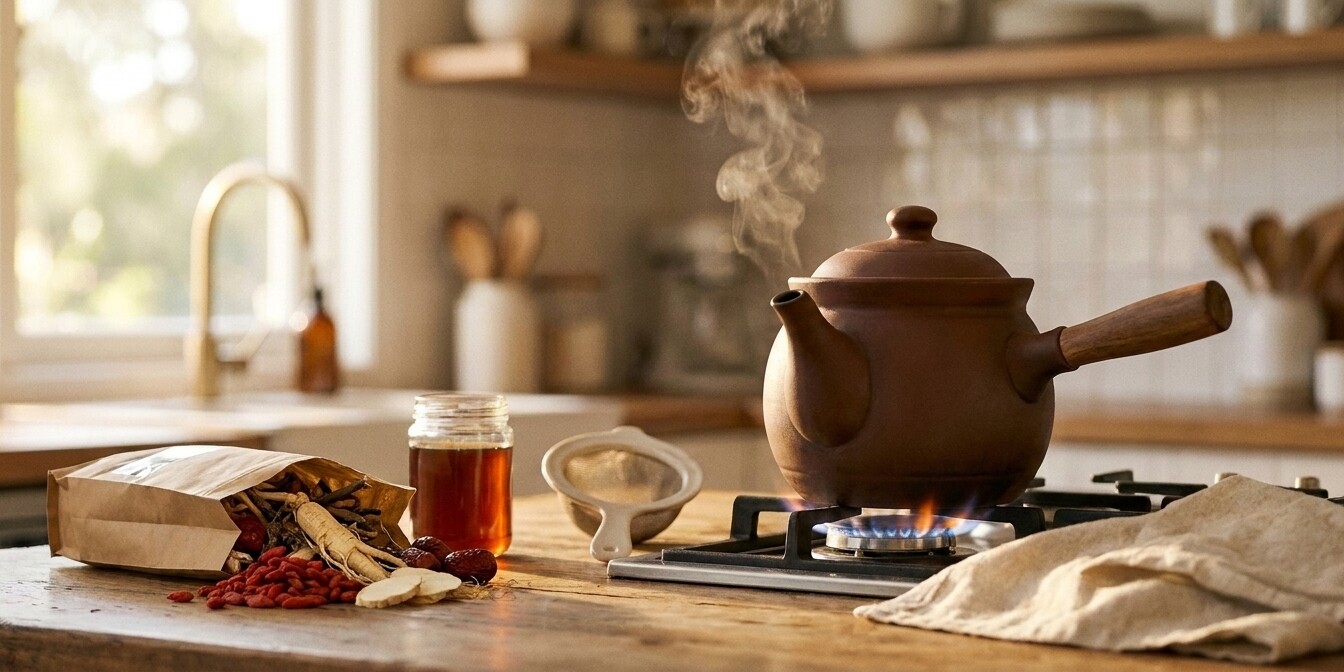
Traditional Chinese clay herb pot simmering raw herbs on a stovetop with goji berries, ginseng and shan yao in a paper bag nearby

How to Cook Raw Chinese Herbs at Home (Step-by-Step Decoction Guide)

So your practitioner sent you home with a brown paper bag of twigs, bark, roots, and what looks suspiciously like a dried mushroom. You're now wondering what on earth to do with it.

This is your guide to cooking raw Chinese herbs (called a decoction) at home, simply, safely, and without setting off the smoke alarm.

If you're taking pills or granules instead, see Tips for Taking Chinese Herbs for that version.

Quick answer

A Chinese herbal decoction is a strong tea made from raw plant parts. Soak the herbs in 3.5 cups of cool water for 20 to 30 minutes, simmer for 30 to 40 minutes, strain off the liquid, then simmer the same herbs again with 2.5 cups of fresh water. Combine both batches (about 2 cups total). For chronic conditions, divide by 4 and drink morning and evening for 2 days. For acute conditions, divide by 2 and drink morning and evening on the same day.

What is a Chinese Herbal Decoction?

A decoction is just a strong tea made from raw plant parts. You soak, simmer, strain, and drink. The water pulls the active compounds out of the herbs and leaves you with a concentrated brew tailored to your body.

Raw herbs are the original form of Chinese herbal medicine. Stronger than pills, more flexible than granules, and (after the first sip) actually quite manageable.

What You'll Need

  • A pot. Glass, ceramic, clay, or stainless steel. Avoid aluminium, copper, cast iron, or anything with a non-stick coating, the metals can react with the herbs.
  • Filtered water. Tap water is fine if your area has decent water, but filtered is better.
  • A strainer or cheesecloth. Something fine enough to catch small bits.
  • A jug or two glass jars. For storing the finished decoction.
  • Your bag of herbs. Usually pre-divided into single-day portions.

A dedicated clay herb cooker is traditional and excellent if you take herbs often, but absolutely not required. A regular saucepan is fine.

How Long One Packet Lasts (Read This First)

Most online guides assume one packet equals one day. In my clinic, that's only true for acute conditions, things like fever, sharp pain, or a flare-up that needs full-strength dosing. For most ongoing treatments, the dosing is gentler and a single packet covers two days.

Here's the breakdown:

  • Chronic conditions (default): 1 packet = 2 days. Cook once, drink across 4 doses.
  • Busy adaptation: 2 packets cooked back to back = 4 days. Same idea, less cooking.
  • Acute conditions: 1 packet = 1 day. Stronger, more frequent dosing. Your practitioner will tell you if this applies.

Always follow what your practitioner has prescribed. If you're not sure which version applies to you, ask before you start.

Step-by-Step: How to Cook Raw Herbs

This is the standard method. It works the same whether you're on the chronic or acute schedule, the only difference is how you split the finished decoction.

1. Open one packet

Each packet is one cooking session. Don't combine packets in the same pot, even if you're cooking two days at once.

2. Soak the herbs

Tip the packet into your pot. Add 3.5 cups (about 875ml) of cool water, enough to cover the herbs by 2 to 3cm. If the herbs are bulky and need more water to cover, add a bit more, that's fine. Let them soak for 20 to 30 minutes. This softens the plant material and helps the active compounds release properly. Skipping the soak gives you a weaker brew.

3. First simmer

Bring to a boil with the lid on, then drop to a low simmer for 30 to 40 minutes. Lid stays on, but slightly cracked so steam can escape. Check occasionally that there's still water in the pot.

⏰ Set a timer. Always. The simmer is gentle and quiet, easy to forget. Come back to a dry pot and you've burnt a week's worth of herbs into the bottom of your saucepan. The smoke alarm will let you know.

4. Strain off the first batch

Pour the liquid through your strainer into a jug. Keep the herbs in the pot.

5. Second simmer

Add 2.5 cups (about 625ml) of fresh water to the same herbs. Simmer again for 20 to 30 minutes. Strain into the same jug.

6. Combine and measure

Mix both batches together. You should end up with about 2 cups (500ml) of finished decoction, give or take depending on how much water you started with. Don't worry about the exact volume, just measure the total and divide it.

How to Split Your Decoction

Take whatever total volume you ended up with and divide it by the number of doses needed:

Chronic conditions (default): 1 packet = 2 days

  • Divide your total volume by 4.
  • Drink one quarter in the morning and one quarter in the evening, for two days.
  • If you finished with 2 cups, that's about ½ cup per dose.

Acute conditions: 1 packet = 1 day

  • Divide your total volume by 2.
  • Drink half in the morning and half in the evening, on the same day.
  • If you finished with 2 cups, that's 1 cup per dose.

Stick with whatever your practitioner prescribed. The dosing reflects the strength your body needs.

When to Take Your Decoction

  • 30 minutes before food, or 1 hour after, for best absorption.
  • Drink it warm, not hot, not cold.
  • Morning and evening, ideally about 12 hours apart.
  • If your practitioner gave different instructions, follow theirs.

How to Drink It (Without Pulling a Face)

The taste is part of the medicine. Bitter, earthy, occasionally swampy. Some formulas are easier than others.

Things that help:

  • Drink it like a small cup of tea, not a shot. Sipping gives your tongue less to react to.
  • Hold your nose for the first few sips if needed.
  • Chase with a small piece of date or candied ginger. Don't add sugar or honey unless approved, some formulas are less effective with sweeteners.
  • Brush your teeth after if the taste lingers.

You'll get used to it within a few days. Most people end up tolerating it fine.

Special Instructions Your Practitioner Might Add

Some herbs need different handling. If your practitioner mentions any of these, follow their lead:

  • Decoct first: Certain herbs (like mineral or shell-based herbs) need 20 to 30 minutes of cooking *before* the rest go in.
  • Add later: Aromatic herbs (like mint or perilla) lose their potency if cooked too long. Add them in the last 5 to 10 minutes only.
  • Wrap in cloth: Some herbs are floaty or fluffy and get wrapped in muslin so they don't end up in your cup.
  • Dissolve separately: Things like gelatin (e jiao) get warmed and stirred in at the end.

If your packet has separate small bags inside the main bag, those are usually the special-handling herbs. Ask if you're not sure.

How to Store Your Decoction

  • Same day: Keep at room temperature in a covered jar. Drink within 12 hours.
  • 1 to 4 days: Refrigerate in glass jars. Warm gently before drinking. Use within 4 days of cooking.
  • Don't microwave if you can avoid it. Warm on the stove, in a hot water bath, or in a thermos. Microwave is fine in a pinch.
  • Don't reuse the cooked herbs after the second simmer. Compost them.

What to Expect

  • The smell will fill your kitchen. Open a window. It fades within an hour.
  • Your urine might smell or look different. That's normal.
  • Some people feel changes within days, others take weeks. Both are normal.
  • If you notice anything unexpected (rash, digestive upset, wired feeling), pause and message your practitioner.

Common Mistakes to Avoid

  • Using a metal pot that reacts. Stick to glass, ceramic, clay, or stainless steel.
  • Skipping the soak. Big difference in potency.
  • Boiling too hard. A gentle simmer extracts the medicine. A rolling boil destroys it.
  • Lifting the lid constantly. Lets the volatile compounds escape.
  • Drinking it cold. Cold decoctions are harder on digestion and less effective.
  • Combining packets to save time. Each packet is a day's dose. Doubling up doesn't double the benefit, it just wastes herbs.

Cooking Two Packets at Once: 4 Days of Herbs in One Session

For single parents and busy professionals, this is the version that actually fits real life. Cook two packets back to back, divide the volume across four days, get on with your week.

How to do it

  1. Cook two packets back to back on the same evening. Use the standard method (soak, simmer, strain, second simmer, combine) for each packet separately. Don't combine the herbs in one pot, each packet needs its own cooking water and timing.
  2. Combine both finished batches into one jug. You should end up with around 4 cups (1 litre) total.
  3. Divide the total by 8 to get your dose. That's about ½ cup per dose, taken morning and evening for 4 days.
  4. Pre-portion into 8 small glass jars or one labelled jug with marked dose lines. Refrigerate.
  5. Each day: warm a portion gently, drink within 5 to 10 minutes.

Tips that make this actually work

  • Cook on Sundays. One cooking session per week covers Monday through Thursday. Repeat midweek for Friday through Monday, or skip ahead with granules on weekends.
  • Cook while you do something else, but SET A TIMER. The simmer is unattended, fold laundry, help with homework, eat dinner. But seriously, set a timer. Forget about it for an hour and you'll come back to a smoky kitchen, a dry pot, and a small pile of very expensive charcoal. Phone alarm labelled "HERBS" is your friend.
  • Use small mason jars (200 to 250ml). Pre-portioned doses you can grab from the fridge.
  • Warm in a thermos for work. Pour the morning dose into a small thermos before you leave. It stays warm for hours.

What you lose by doing this

About 10 to 20% of the medicinal strength compared to drinking it the same day, mostly from volatile aromatic compounds. For most chronic conditions this is a fair trade for the consistency. For acute presentations (fever, infection, sharp pain), fresh wins, cook daily if you can.

What not to do

  • Don't stretch the schedule beyond 4 days. Past that, the decoction loses potency and can spoil.
  • Don't freeze unless your practitioner specifically says it's okay for your formula.
  • Don't combine the raw herbs from both packets into one giant pot. Each packet cooks separately, then you combine the liquid.
  • Don't store in plastic. Glass jars only.

If you're considering this, mention it to your practitioner. They might suggest granules instead, which are designed for exactly this kind of busy life and skip the cooking entirely.

Why Bother With Raw Herbs Instead of Pills?

Raw herbs are the most powerful form of Chinese medicine. They're tailored to your exact pattern, can be adjusted week by week, and the act of preparing them is part of the medicine. You connect with the process.

That said, they're a commitment. If your schedule doesn't allow daily cooking, ask your practitioner about granules or pills as alternatives.

Want Help With Your Formula?

If you've been prescribed raw herbs and you're not sure how to handle yours specifically, or you want to check whether your formula is still the right fit, book a follow-up or message me. The first cook is always the hardest. After that, it's just part of your routine.

If you want a deeper understanding of how Chinese medicine works (and how to get the most out of treatment), I'm writing a book called Before the Needles. Sign up for early access and get a free chapter when it's ready.


Frequently Asked Questions

How long does it take to cook raw Chinese herbs?

Soak for 20 to 30 minutes, then simmer for 30 to 40 minutes for the first batch and 20 to 30 minutes for the second. Total active time is around 90 minutes, but most of that is unattended.

Can I use a slow cooker or Instant Pot?

Yes for an Instant Pot (use the slow cook or sauté/simmer function, not pressure). Slow cookers can work but don't get hot enough on low, use the high setting and check the temperature reaches a true simmer. A regular pot on the stove is still the most reliable.

How long do raw herbs last?

Dry, sealed, in a cool dark place: usually 2 to 3 months. Once cooked, drink within 48 hours and keep refrigerated.

Can I use a microwave to reheat my herbs?

Yes, a quick gentle reheat in the microwave is fine, the stove or a hot water bath is preferred but the microwave won't ruin your formula. Just don't let it come to a rolling boil again once it's been prepared, you're warming it, not re-cooking it.

Can I cook all my packets at once and freeze them?

Freezing isn't recommended, the medicine works best fresh or refrigerated. But cooking 2 packets at once for 4 days of doses is a solid adaptation if you can't cook midweek. See the section above for the method.

Do I have to drink it all in one go?

No. Sip it like tea over 5 to 10 minutes. Splitting into smaller portions across the morning is also fine if your stomach is sensitive.

What if I miss a dose?

Take the next dose at the normal time. Don't double up. Consistency matters more than perfection.


About the author

Eric Higashino is a registered Chinese medicine practitioner (AHPRA) and acupuncturist based in Ballina, NSW, Australia. He treats chronic and complex conditions including Gu Syndrome, mould-related illness, MCAS, POTS and digestive disorders using Chinese herbal medicine, acupuncture and moxibustion. Read more about Eric or book a session.


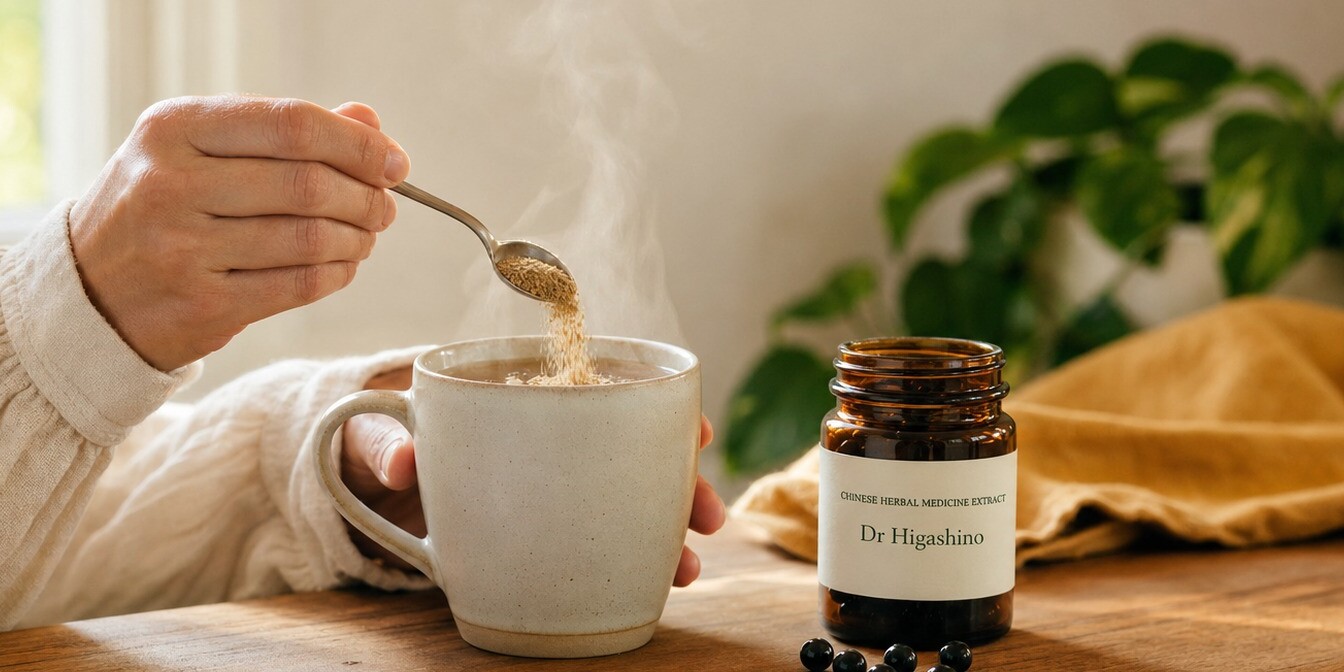
Hands stirring Chinese herbal granules into a warm cup of water on a kitchen counter, with a Dr Higashino patent pill bottle beside it.

Are You Drinking Chinese Herbs Wrong? Timing and Form Matter

If you're new to Chinese herbs, you're not alone in wondering things like: "Do I take these with food?" or "How am I supposed to remember three times a day?"

This guide is here to help. Whether you're taking patent pills or granules, there are simple ways to build them into your routine so they actually do what they're meant to, support your healing. And no, you don’t need to be perfect to see results. In Chinese medicine, consistency matters more than perfection. Let’s make this simple and doable.

Quick answer

Take your Chinese herbs 30 minutes before food or 1 hour after eating, with warm water. For patent pills, swallow the prescribed number whole. For granules, dissolve 1 teaspoon in 100 to 150ml of warm water and drink like tea. Take consistently, ideally 2 to 3 times a day. Consistency matters more than perfect timing, even imperfect dosing beats skipping.

Where should I get Chinese herbs?

It's best to get your Chinese herbs from a qualified practitioner who can properly diagnose your TCM pattern and match the right formula to your body. Herbal formulas are powerful when used correctly, but not all herbs are suitable for all bodies. You might find herbs online or at health stores, but without a full understanding of the formula, you might not get the results you want, or worse, you could aggravate your symptoms.

If you are prescribed raw herbs (the kind you cook at home), check out my guide on How to Cook Raw Chinese Herbs for extra tips.

What are the main forms of Chinese herbs?

Patent Pills:

  • Small, round, easy to swallow.
  • Great for travel and busy schedules.
  • Best for when your formula stays consistent over time.

Granules:

  • Powdered extract form.
  • Dissolve easily in warm water
  • Easier to adjust dosage depending on how you’re responding.

Taste Tip: Sensitive to tastes? Pills are usually easier. Want a stronger, faster effect? Granules are often more potent.

When should I take my Chinese herbs?

Ideally, take your herbs 30 minutes before meals or 1 hour after eating. This timing helps your body absorb the herbs without the interference of digestion.

BUT: It’s far more important to actually take your herbs consistently, even if the timing isn’t perfect.

If you forget and it’s mealtime? Take them anyway. Your body benefits more from steady support than from occasional "perfect timing."

How can I remember to take my herbs?

Four ways to remember to take Chinese herbs: bottle next to kettle and coffee, phone alarm labeled Herbs at 8:30 AM, bottle next to toothbrush, and bottle in a handbag.
  • Visual reminders: Leave your herbs next to your toothbrush, kettle, or coffee machine.
  • Phone alarms: Set recurring reminders labeled “herbs.”
  • Habit stacking: Link it to a habit you already have. Example: "I brush my teeth → I take my herbs."
  • Portable options: If you’re using pills, keep a small bottle in your bag or car.
  • Weekly organizer: Especially helpful if you have multiple formulas or a busy schedule.

Pro tip: Treat it like brushing your teeth, not dramatic, just part of daily care.

Writing a book on what every patient should know.
Get early access (and a discount) to Before the Needles. Sign up free →

How do I take Chinese herbs?

Patent Pills:

  • Simply swallow the prescribed number of pills with water
  • Try to avoid chewing as the taste can be strong

Granules:

  • Measure the prescribed dose
    • Typically for an adult, 1 teaspoon 3 times a day or 1.5 teaspoons 2 times a day
  • Dissolve the granules in about 100-150ml of warm water (about ½ to ⅔ cup)
  • Stir until fully dissolved
  • Drink it like tea

What if I can't stand the taste of granules?

If the taste of granules feels overwhelming, you're not alone. Here are a few easy tricks to make them more manageable:

  • Chase it technique: Instead of mixing it, place the dry powder on your tongue, then quickly wash it down with warm water.
  • Dilute more: Use a larger cup of warm water to spread out the flavor.
  • Mix with something pleasant: Add a splash of warm apple juice or a little honey after dissolving the herbs.
  • Use a straw: Sip the liquid with a straw to bypass most of your taste buds.
  • Chase it: Drink the granules quickly, then follow immediately with a sip of tea, water, or juice.
  • Temperature matters: Make sure the water is warm but not too hot, as extremely hot water can intensify the bitterness.

Remember: the flavor is part of the medicine, but it's absolutely okay to make it easier on yourself!

What should I expect (taste, texture, timing)?

Granules:

  • Earthy, slightly bitter taste is normal.
  • Mix with warm water, add a splash of honey or warm apple juice if needed.
  • Drink it like tea, not all at once like a shot.

Pills:

  • Swallow with water.
  • Don’t chew them (trust me on this one).

Timing expectations:

  • Some people notice changes quickly; others feel a slow, steady improvement.
  • Trust the process. Your body is working with the herbs, not just being "forced" to change.

Why does consistency matter with Chinese herbs?

Chinese medicine is about supporting your body’s natural rhythms. It’s like watering a plant: a little, regularly, is far better than dumping a bucket once a week.

Taking your herbs consistently helps your body gently shift back into balance. This matters even more if you're working through a damp pattern or chronic condition. Skipping doses interrupts that support. Even imperfect dosing, as long as it’s steady, is better than aiming for perfection and doing nothing.

Herbs work on the deep ecosystems of your body. They're not a "band-aid"; they're helping rebuild the soil, not just trimming the weeds.


Want to get the most out of your herbs?

If you have herbs at home and you're not sure how to take them, or your formula is part of treatment for a complex condition like Gu Syndrome, or you want to make sure your current formula is still the best fit, I’m here to help.

Book a follow-up or send me a message. Your body deserves consistent support, and you deserve to feel your best.


About the author

Eric Higashino is a registered Chinese medicine practitioner (AHPRA) and acupuncturist based in Ballina, NSW, Australia. He treats chronic and complex conditions including Gu Syndrome, mould-related illness, MCAS, POTS and digestive disorders using Chinese herbal medicine, acupuncture and moxibustion. Read more about Eric or book a session.


What to read next


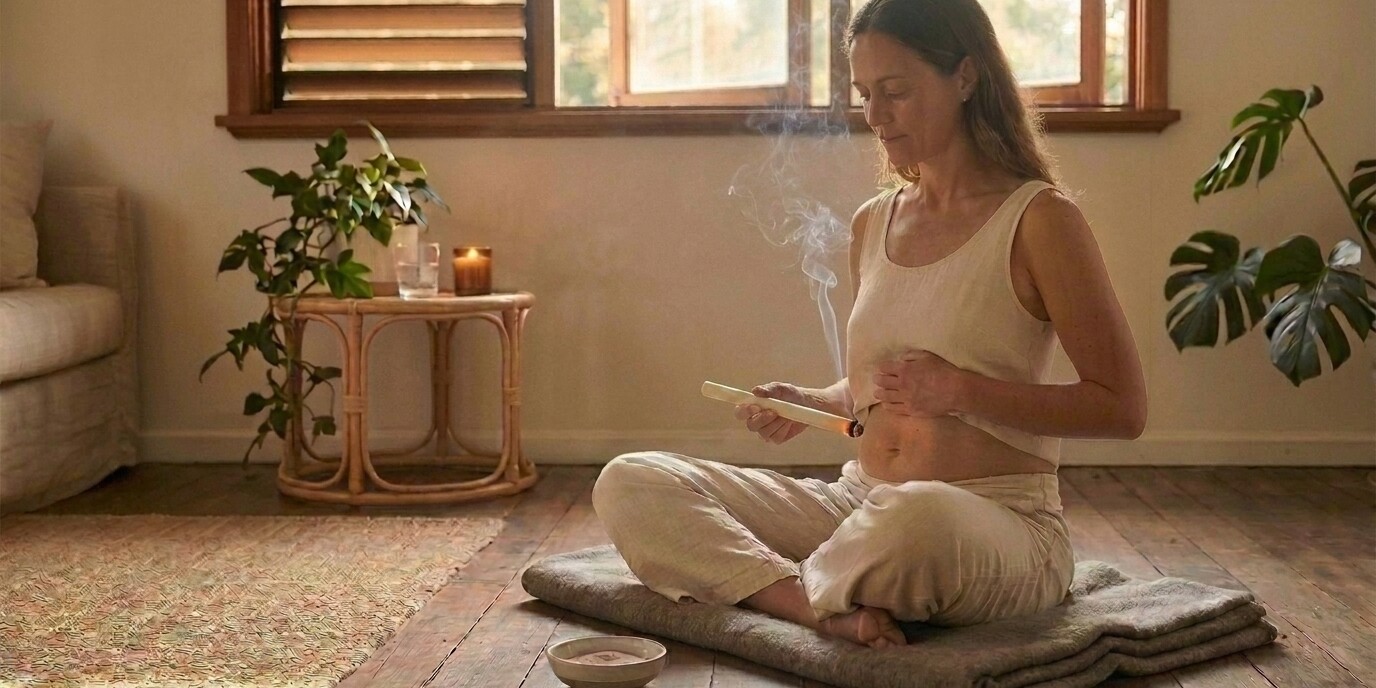
Woman seated cross-legged on a folded grey cushion in a sunlit room, holding a moxa stick horizontally with the glowing ember tip hovering just above her bare lower belly, a thin wisp of smoke rising from the ember and a small ceramic bowl on the floor for ash

How to Use Moxa Sticks at Home: A Step-by-Step Guide

So your acupuncturist told you to try moxa at home and now you’re holding a stick of herbs wondering if you’re about to summon a spirit or start a campfire in your lounge room.

You’re in the right place.

This is your definitive guide to using moxa at home, safely, confidently, and in a way that actually supports your health (without triggering the smoke alarm). Whether you’re dealing with cold feet, cramps, fatigue, or just need some inner warmth, this ancient therapy has your back. Literally.

What is moxa therapy?

Moxa therapy (moxibustion) is a Chinese medicine treatment that uses dried mugwort (Artemisia vulgaris) burned near the skin to warm specific acupuncture points. Practitioners use it to ease cold, fatigue, pain, and period and fertility issues, often alongside acupuncture or as a self-care tool at home.

Types of Moxa

There are many kinds of moxa, but for this guide I will go over the common moxa stick that acupuncturists usually give to patients to use. It can be either regular or smokeless.

The smokeless kind looks like a long charcoal stick that you put in a bbq. The regular looks like a large cigar with dried herbs inside.

The smokeless moxa isn't quite smokeless, but less smokey, so both will have smoke.

Many people say moxa smells like marijuana. Others say it has hints of tobacco, eucalyptus, and sage notes, or a mild, licorice-like scent with hints of green apples. The higher quality Japanese aged moxa has a more pleasant smell and the smokeless has a more muted smell and doesn't have the same aromatics.

Is Moxibustion Safe to Do at Home Without a Practitioner?

Yes, for most people. Moxa sticks are one of the few tools in Chinese medicine specifically designed for home use, and they have a long history of safe self-application. You don't need a practitioner present to use one.

The main safety considerations are straightforward: you should feel warmth, not burning. Keep the stick moving so heat doesn't concentrate on one spot. Have a glass of water nearby to extinguish it safely when done. Don't use moxa over broken skin, on numb areas, or on your face. And if you're pregnant, check with your practitioner first, some points are contraindicated during pregnancy.

Beyond those basics, moxa is forgiving. If you're warming the wrong point, nothing bad happens, you just don't get the benefit. The step-by-step guide below covers technique, timing, and which points to use for common patterns.

How to Use Moxa

First, you are about to light something on fire, so make sure to have plenty of ventilation so you aren't choking on the smoke. Open some windows and have some good air flow or if it's warm enough you can do it outside.

Think of moxa like a giant incense stick on steroids, it's going to have a strong scent and unless you want it to stick around for days get some air flow going.

Top-down flat-lay of moxa essentials: a single moxa stick, a small ceramic bowl filled with sand for extinguishing, and a classic white lighter, arranged on a warm timber surface
What you need to do moxa at home: a moxa stick, a small bowl of sand, and a lighter.

What to Have Ready

  1. Moxa Stick (regular or smokeless)
  2. Extinguishing Tool (jar or salt, sand or rice)
  3. Lighter (a windproof butane lighter works faster for smokeless moxa)

How to Use the Moxa

Three-panel diagram showing the three moxa stick techniques: circle (rotate slowly over the point), peck (lower in then back out), and sweep (glide back and forth), each performed about 2 to 3 cm above the skin
The three ways to move a moxa stick over a point: circle, peck, and sweep, all held about 2 to 3 cm above the skin.
  1. Light the stick until the entire tip glows red. Smokeless can take a while to have the whole tip glow red

  2. Hover it 2 to 3cm above the skin over specific the acupuncture points you were told to warm (don’t touch the skin).

  3. Circle or dip the stick slowly, like you’re roasting a marshmallow, but the marshmallow is your Qi.

  4. Stop after 5 to 15 minutes, or when the area feels warm and slightly pink.

  5. Extinguish in a jar of salt, sand, or rice. (Don’t douse it in water, it’ll ruin the stick.)

Want to know if moxa is right for you?
Book a session and I'll make a custom moxa plan tailored to your pattern. Book here →

What Points Should I Moxa

Ideally you should have a qualified acupuncturist to diagnose you and guide you on what points would work best for you.

Here are some guidelines for common indications:

Moxa for Fatigue

Feeling like your battery never quite charges to 100%?

Use moxa over your lower back and just below the belly button (DU-4, REN-4, Ren 6). These are the power stations of your body in Chinese medicine, your Qi bank account. See images below for exact points.

Acupressure point DU 4 (Mingmen) located on the spine just below the waistline, level with the belly button, two vertebrae above the iliac crest line
DU 4 sits on the spine just below the waistline, level with the belly button.
Acupressure point Ren 4 (Guanyuan) located four finger-widths below the belly button on the body's midline, marked with an orange dot and a hand showing the four-finger measurement
Ren 4 sits four finger-widths below the belly button, on the midline.
Acupressure point Ren 6 (Qihai) located two finger-widths below the belly button on the midline, marked with an orange dot and a two-finger measurement from the navel
Ren 6 sits two finger-widths below the belly button, on the midline.
  • Do it at night, especially when you’re tired but wired.
  • Combine with rest, warm food, and low screen time for best results.

You can also strengthen your Spleen Qi with diet and acupressure alongside moxa.

Moxa for Cold Hands, Feet, Belly

If you’re always the cold one in the room, this is your herbal heat lamp.

Use moxa on bottom of the feet, belly, and low back. This warms your Yang, think of it like jump-starting the fire in your internal fireplace. See images below for exact points (KID-1, REN-6, REN-8, DU-4).

Acupressure point KD 1 (Yongquan) on the sole of the foot, in the depression that forms when the toes curl, located at the upper third of the sole between the second and third toes
KD 1 sits in the dip on the sole that forms when you curl your toes.
Acupressure point Ren 6 (Qihai) located two finger-widths below the belly button on the midline, marked with an orange dot and a two-finger measurement from the navel
Ren 6 sits two finger-widths below the belly button, on the midline.
Acupressure point Ren 8 (Shenque) located at the centre of the navel, with an orange arrow pointing to the belly button on a simple female torso line drawing
Ren 8 is the belly button itself, used with moxa rather than needles.
Acupressure point DU 4 (Mingmen) located on the spine just below the waistline, level with the belly button, two vertebrae above the iliac crest line
DU 4 sits on the spine just below the waistline, level with the belly button.

If you also feel heavy and foggy, dampness may be combined with yang deficiency.

Moxa for Pain

Moxa loves pain that improves with heat.

If your ache gets better with a hot water bottle or a warming muscle rub, it’ll likely love moxa.

Use it on or around the area of pain (muscle, joints, etc.), keeping it hovering, not touching.

Great for:

  • Lower back pain

  • Menstrual cramps

  • Neck & shoulder tension

  • Cold knees or feet

Bonus: It increases circulation, reduces inflammation, and calms the nervous system.

Moxa for Period Health

Painful, heavy, irregular, or absent periods? Moxa brings balance.

To help warm the womb, regulate blood flow, and ease cramps use moxa on your inner calf, lower belly, and low back (SP-6, REN-4, REN-6, DU-4). Do it in the week leading up to your period. See images below for exact locations.

Acupressure point SP 6 (Sanyinjiao) located four finger-widths above the inner ankle bone, just behind the shinbone
SP 6 sits four finger-widths above the inner ankle bone.
Acupressure point Ren 4 (Guanyuan) located four finger-widths below the belly button on the body's midline, marked with an orange dot and a hand showing the four-finger measurement
Ren 4 sits four finger-widths below the belly button, on the midline.
Acupressure point Ren 6 (Qihai) located two finger-widths below the belly button on the midline, marked with an orange dot and a two-finger measurement from the navel
Ren 6 sits two finger-widths below the belly button, on the midline.
Acupressure point DU 4 (Mingmen) located on the spine just below the waistline, level with the belly button, two vertebrae above the iliac crest line
DU 4 sits on the spine just below the waistline, level with the belly button.

For best results before treatments, see how to track your cycle for your acupuncturist.

Moxa for Fertility

Moxa is one of the best ways to prepare the body for conception. Think of inviting the baby into a warm belly that would love to spend time there. To start the process moxa the bottom of your foot, lower belly, and just below your knee (KID-1, REN-4, REN-6, ST-36). See images below for exact locations.

Acupressure point KD 1 (Yongquan) on the sole of the foot, in the depression that forms when the toes curl, located at the upper third of the sole between the second and third toes
KD 1 sits in the dip on the sole that forms when you curl your toes.
Acupressure point Ren 4 (Guanyuan) located four finger-widths below the belly button on the body's midline, marked with an orange dot and a hand showing the four-finger measurement
Ren 4 sits four finger-widths below the belly button, on the midline.
Acupressure point Ren 6 (Qihai) located two finger-widths below the belly button on the midline, marked with an orange dot and a two-finger measurement from the navel
Ren 6 sits two finger-widths below the belly button, on the midline.
Acupressure point ST 36 (Zusanli) located four finger-widths below the kneecap and one finger-width lateral to the shinbone
ST 36 sits four finger-widths below the kneecap, one finger-width off the shinbone.
  • Use 3 to 4 times per week for a few cycles leading up to conception.
  • Partners can do it too, for sperm health and vitality.
  • Think of it as “warming the soil before planting seeds.”

When Not to Use Moxa

While moxa is gentle and nourishing, it’s not for everyone or every situation. Here’s when to skip the stick (or at least check with your practitioner first):

Don’t Use Moxa If:

  • You have a fever, infection, or inflammation
    • Moxa adds heat. If your body’s already burning up (like with a flu, UTI, or skin infection), adding more fire can make things worse. If you suspect chronic infection or stealth illness, read about Gu Syndrome and chronic complex illness.
  • You’re pregnant (without supervision)
    • Some points (like certain abdominal or lower back spots) can be contraindicated during pregnancy.
    • However, supervised moxa, like on Bladder 67 for breech babies, is safe and widely used. Just don’t DIY unless your practitioner says it’s okay.
  • You have numbness or poor sensation
    • If you can’t clearly feel heat, you risk burning yourself. This includes diabetic neuropathy or post-stroke numbness.
  • The area has open wounds, rashes, or varicose veins
    • Don’t apply moxa over broken skin, inflamed tissue, or bulging veins.
  • You have asthma or are sensitive to smoke
    • Moxa smoke can irritate the lungs. Use smokeless moxa, or ask for a heat lamp alternative.
  • You’re overheated or have signs of excess heat
    • Think: red face, dry mouth, night sweats, hot flushes, restlessness. Moxa could make it worse.
    • (Let’s cool you down first, then we can talk fire.)

Always Talk to Your Practitioner If:

  • You’re unsure what points to use

  • You’re dealing with a complex or chronic condition

  • You’re pregnant, postpartum, or trying to conceive

Final Tips

  • Ventilate well, It’s smoky, but the scent is part of the healing

  • Never leave a burning stick unattended, Sounds obvious, but you’d be surprised.

  • Pair it with rest and stillness, Let your body integrate the warmth

  • Mark your points, Ask me to show you exactly where to use it

  • Don’t overdo it, 10 minutes per point is enough

Want Personal Guidance?

Not sure where to start or what points are best for you? Book a session or ask during your next treatment, I’ll make a custom moxa plan just for you.


What to read next