
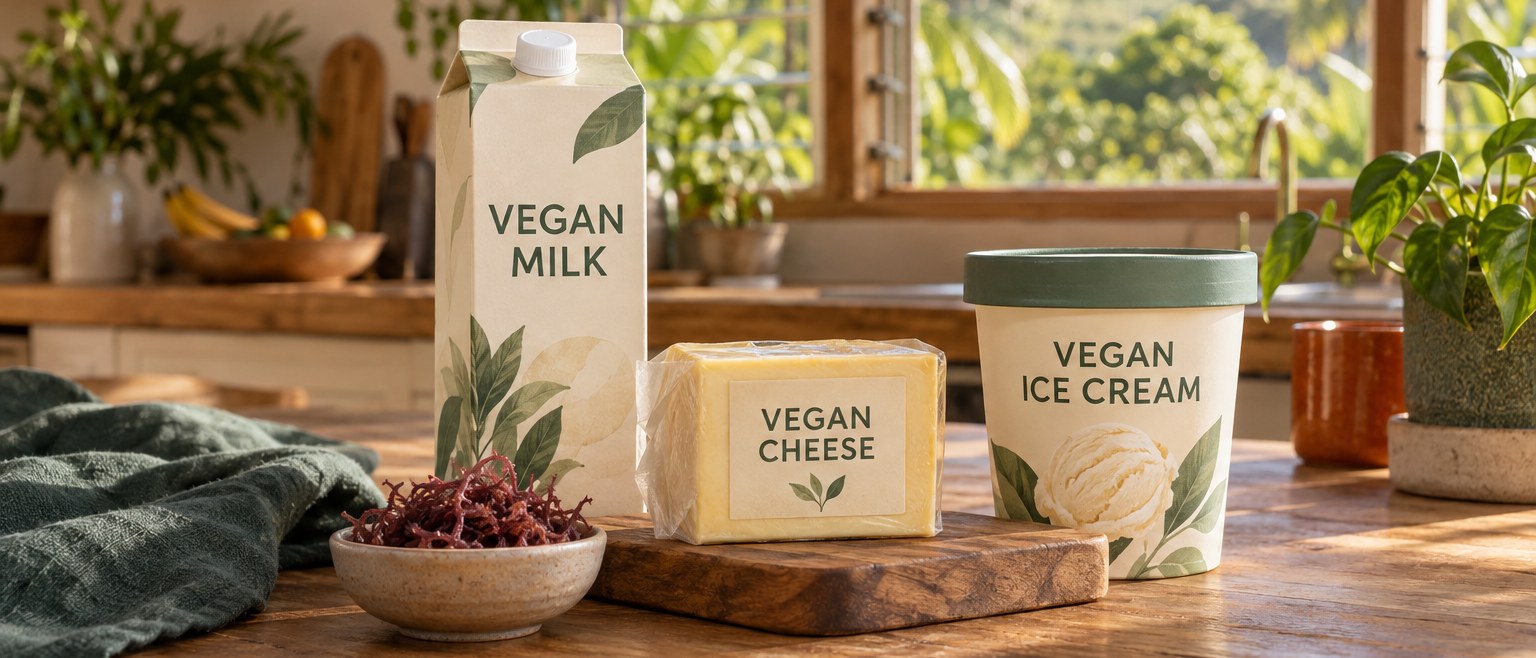
Carrageenan is a seaweed thickener found in everything from cream to vegan cheese. It contains no animal products, yet some people with alpha-gal syndrome (mammalian meat allergy) say it sets off their reactions. Here’s what’s known and what isn’t, who might need to avoid it, and how to spot it on Australian labels.
Key points
- Carrageenan comes from red seaweed, not mammals.
- Its sugar chains are built from galactose, partly linked in the same way as alpha-gal. That’s why a link has been proposed.
- No study has yet shown that carrageenan causes alpha-gal reactions. In a 2026 US survey of people with alpha-gal, about 1 in 9 said they react to carrageenan, the third most common answer after dairy and medicines.
- ASCIA, Australia’s peak allergy body, lists seaweed thickeners as safe for mammalian meat allergy, except carrageenan.
- Most people with alpha-gal probably tolerate it. If you keep reacting after cutting out meat, dairy and gelatine, it’s worth looking at.
- On Australian labels look for “carrageenan”, 407 or 407a. It’s very common in vegan products.
In this article: What is carrageenan? · Why it might matter · What the evidence says · Who should consider avoiding it · Where it’s found · The vegan trap · Reading labels · Working out if it affects you · FAQs
What Is Carrageenan?
Carrageenan is extracted from red seaweeds, including Irish moss. It thickens, gels and stabilises food, and stops ingredients separating. That makes it useful in dairy foods, desserts, processed meats and especially plant-based products.
There are three main types, called kappa, iota and lambda. They give different textures, from firm gels to creamy thickness.
In Australia it appears on labels as carrageenan or additive 407. A closely related ingredient, processed eucheuma seaweed (407a), is less refined seaweed that still contains carrageenan. European food regulators assess the two together.
Why Might Carrageenan Matter for Alpha-Gal?
Alpha-gal is a sugar: two galactose molecules joined by a particular kind of link. Carrageenan is a long chain of galactose sugars, and some of its links are of the same kind. In 2015 a US researcher, writing in the Journal of Allergy and Clinical Immunology, pointed out this similarity and suggested carrageenan could act like alpha-gal in the body.
That’s a theory. Carrageenan’s structure differs from alpha-gal in other ways (for example, its sugars carry sulphate groups), and whether the immune system of someone with alpha-gal actually recognises it is still unclear.
What Does the Evidence Say?
| Source | What it says |
|---|---|
| ASCIA (Australia) | Lists seaweed-based thickeners as safe for mammalian meat allergy, except carrageenan. Confusingly, the same sentence also lists additives “400 to 407a” as safe, a range that includes carrageenan (407). |
| Lab research (2024) | A French study found that small carrageenan fragments, made in the lab with enzymes, bound to human antibodies that recognise alpha-gal. These weren’t the IgE antibodies that drive allergic reactions, and the study didn’t involve people with alpha-gal, so it supports the structural overlap without proving carrageenan triggers reactions. |
| US medical review (2022) | Notes it has been proposed that carrageenan affects a minority of people with alpha-gal, but there are no reports yet showing these people react through alpha-gal, and no reported cases of severe reactions or anaphylaxis to carrageenan in alpha-gal. |
| Patient survey (2026) | In a 2026 US survey of people with alpha-gal, about 1 in 9 said they react to carrageenan, the third most common answer after dairy and medicines. These were self-reports from people using a US medicine-checking service, not confirmed by testing. |
| Carrageenan allergy | Separate, rare allergies to carrageenan itself have been reported in people without alpha-gal. |
So the honest summary is: we don’t know yet. The evidence for a direct link is weak, but patient reports are consistent enough that Australia’s peak allergy body errs on the side of caution. It’s possible a small group of people with alpha-gal react to carrageenan, or that some reactions blamed on it really come from other ingredients in the same foods, such as dairy.
Who Should Consider Avoiding Carrageenan?
You may want to look at carrageenan, with your doctor’s guidance, if:
- You’re still reacting after cutting out mammal meat, dairy (if it affects you) and gelatine
- You’ve reacted to vegan cheese, plant milk, vegan desserts or chicken deli meats
- You’re very sensitive and react to small traces of mammal ingredients
- You’ve had reactions you can’t explain with anything else in your food diary
If your alpha-gal is well controlled and you eat carrageenan without problems, you probably don’t need to cut it out. Every extra food you avoid makes eating harder, so only restrict what you need to.
Where Is Carrageenan Found?
| Category | Common examples |
|---|---|
| Plant-based and vegan | Vegan cheese, plant milks (oat, almond, soy, coconut), vegan ice cream, vegan custard and desserts, plant-based deli slices |
| Dairy | Cream, thickened cream, flavoured milk, ice cream, custard, some yoghurts, cottage cheese, cream cheese |
| Meat and deli | Chicken and turkey deli slices, processed chicken, ham (already off the menu) |
| Desserts and sauces | Jelly-style desserts, mousses, cheesecakes, pie fillings, sauces and dressings |
| Capsules and supplements | Some vegetarian softgel capsules use carrageenan instead of gelatine |
| Other | Toothpaste, some cosmetics, “sea moss” gels and supplements |
Sea moss. Sea moss gels and capsules, popular on social media, are made from the same red seaweeds carrageenan comes from. If you’re avoiding carrageenan, avoid sea moss too.
The Vegan Trap
Vegan products are a natural choice when you have alpha-gal, because they contain no mammal ingredients. But carrageenan is one of the most widely used thickeners in plant-based food, so switching to vegan can quietly add a lot more of it to your diet.
If carrageenan may affect you, stay away from vegan products that contain it. Vegan pizza is a common example: the vegan cheese often contains carrageenan, and it’s usually cooked in the same oven as meat pizzas. Plant milk in your coffee, vegan ice cream and vegan cheese slices are other everyday sources. Check every label, because recipes differ between brands and change over time.
Switching from gelatine capsules to vegetarian capsules can do the same thing, since some vegetarian softgels are made with carrageenan.
How to Spot Carrageenan on Australian Labels
Carrageenan can be listed as:
- Carrageenan
- Thickener (407), vegetable gum (407) or stabiliser (407)
- Processed eucheuma seaweed, or 407a
- Irish moss
ASCIA lists other thickeners as safe for mammalian meat allergy, including xanthan gum (415), gellan gum (418) and pectin (440), along with other seaweed-based thickeners such as agar and alginates. Products that use these instead of carrageenan are good alternatives.
Carrageenan isn’t an allergen that has to be declared in bold on Australian labels, so read the full ingredient list. If you’re unsure, contact the manufacturer.
How Do I Work Out if Carrageenan Affects Me?
- Keep a detailed diary of foods, brands, times, cofactors (exercise, alcohol, painkillers) and symptoms. Alpha-gal reactions are delayed, so record when symptoms start. My guide to alpha-gal symptoms explains the typical timing and signs.
- Talk to your immunologist about trialling a carrageenan-free diet for a few weeks, alongside your usual mammal-free diet.
- Note any change in how often and how badly you react.
- Don’t test it again on your own if you’ve had a severe reaction. Any reintroduction should be planned with your doctor.
There’s no reliable blood test for a carrageenan reaction in alpha-gal, so a careful diary and trial is the most practical way to find out.
Frequently Asked Questions
Is carrageenan an animal product?
No. It’s extracted from red seaweed. The concern with alpha-gal is about its sugar structure, not its source.
Does everyone with alpha-gal need to avoid carrageenan?
No. Most people with alpha-gal probably tolerate it. Consider avoiding it if you keep reacting after removing mammal ingredients, or if you’ve reacted to foods that contain it.
Why does ASCIA list carrageenan as an exception?
ASCIA’s mammalian meat allergy FAQ lists seaweed-based thickeners as safe except carrageenan. This reflects patient reports and its possible structural similarity to alpha-gal.
Is 407a the same as carrageenan?
Processed eucheuma seaweed (407a) is a less refined form that still contains carrageenan. If you’re avoiding carrageenan, avoid 407a too.
Is vegan cheese safe with alpha-gal?
It contains no mammal ingredients, but many brands contain carrageenan. If carrageenan may affect you, choose brands without it.
Is sea moss safe with alpha-gal?
Sea moss is a source of carrageenan. If you’re avoiding carrageenan, avoid sea moss gels and supplements as well.
Is agar safe?
Agar also comes from seaweed, but it’s a different substance. ASCIA lists seaweed thickeners other than carrageenan as safe.
Still reacting despite a careful diet?
Book a consultation in Ballina to talk through Chinese medicine and SAAT ear acupuncture as support alongside your medical care.
Book a consultationSAAT for alpha-gal
SAAT is a complementary approach and doesn’t replace allergy testing or emergency care.
New to alpha-gal? Start with my full guide to alpha-gal syndrome in Australia, including other hidden sources of alpha-gal and safe tick removal.
New to Chinese medicine?
My book, Before the Needles: What You Should Know About Chinese Medicine, explains how it works and what to expect, in plain English. Join the early access list to read it first.
About the author
Eric Higashino, B.H.Sc. (Chinese Medicine), is an AHPRA-registered Chinese Medicine Practitioner (CMR0002758292) and AACMA member. He practises at Kentro Health, 18 Cherry St, Ballina NSW. This article is general information and doesn’t replace advice from your doctor, immunologist or dietitian.
Last updated November 2026
References
- ASCIA. Mammalian meat allergy and tick allergy FAQ.
- Tobacman JK. The common food additive carrageenan and the alpha-gal epitope. J Allergy Clin Immunol. 2015;136(6):1708-1709. PubMed 26518095.
- Sokolova E, et al. Enzymatically-derived oligo-carrageenans interact with α-Gal antibodies and Galectin-3. Carbohydr Polym. 2024;324:121563. PubMed 37985065.
- Uchi, Hughes, Nourian, Meinholz, et al. Carrageenan: a non-mammalian allergen in alpha-gal syndrome. J Allergy Clin Immunol. 2026 (abstract). doi:10.1016/j.jaci.2025.12.676.
- Macdougall JD, Thomas KO, Iweala OI. The meat of the matter: understanding and managing alpha-gal syndrome. ImmunoTargets Ther. 2022;11:37-54. PMC9484563.
- Borsani B, et al. The role of carrageenan in inflammatory bowel diseases and allergic reactions: where do we stand? Nutrients. 2021;13(10):3402. PubMed 34684400.
- EFSA Panel on Food Additives. Re-evaluation of carrageenan (E 407) and processed Eucheuma seaweed (E 407a) as food additives. EFSA J. 2018. PMC7009739.