
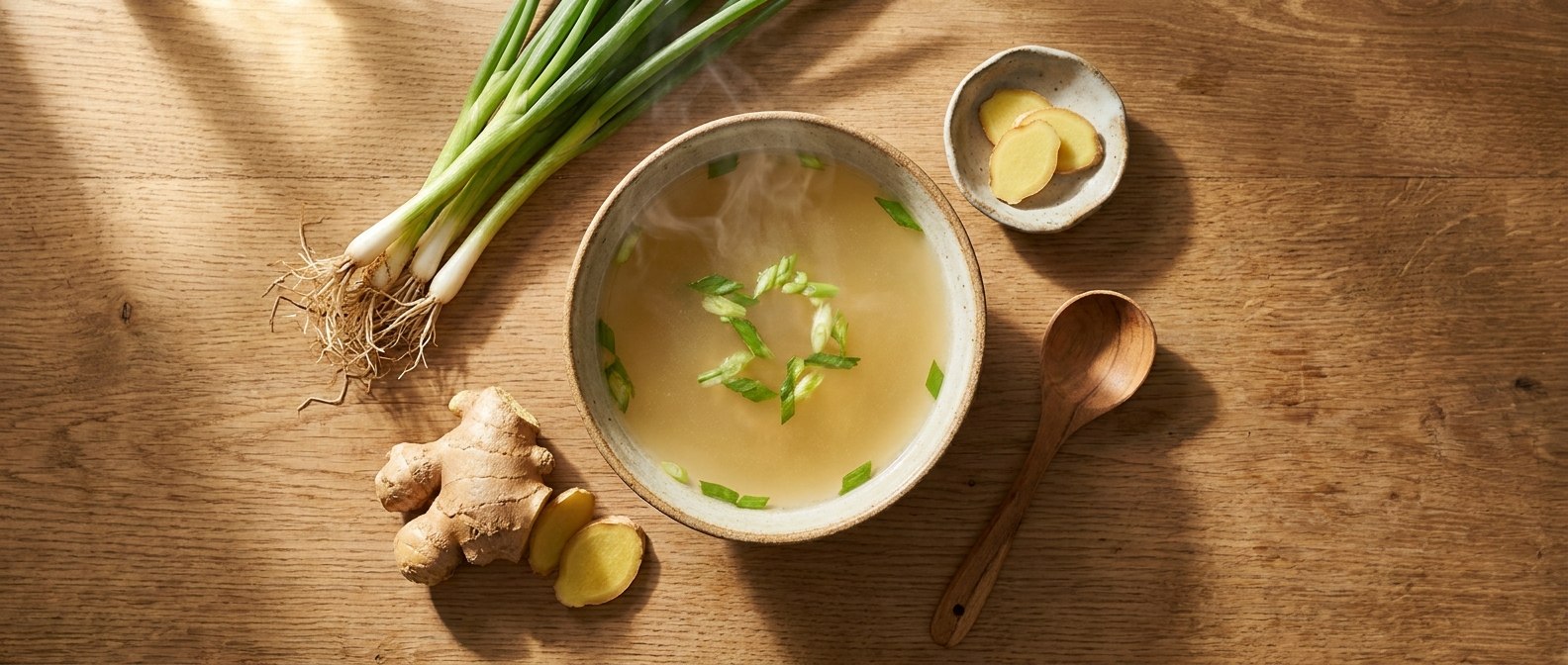
Ginger and Scallion Soup: Chinese Medicine’s Home Remedy for the First Sign of a Cold
Something about the first tickle. It arrives in the back of your throat on a cold evening and you're not sure if it's anything yet. Could be nothing. But your body knows.
Chinese medicine has a very specific answer to this moment. Not a cabinet full of supplements. Not a trip to the chemist. Just three ingredients from your kitchen, a pot, fifteen minutes, and a blanket.
This soup has been used in Chinese medicine for centuries. It goes by the name Cong Bai Sheng Jiang Tang (葱白生姜汤), scallion white and fresh ginger decoction. It is not complicated. That is the point.
Quick answer
Cong Bai Sheng Jiang Tang is a Chinese medicine decoction made with scallion whites, fresh ginger, and broth. Simmer for 15 minutes, drink hot, then bundle up and rest. It is traditionally used to release wind-cold from the exterior of the body in the first 24 to 48 hours of a cold. Timing matters, act at the first sign of symptoms, before the pattern has a chance to develop further.
Is This Soup Right for What You Have?
This is the part most recipes skip. They give you the ingredients and send you on your way. But this soup only works for one type of cold. Use it for the wrong pattern and it will not help.
In Chinese medicine, the common cold typically falls into two main types: wind-cold and wind-heat. This soup is for wind-cold.
Here is how to tell which one you have.
Wind-cold looks like this:
- More chills than fever, you feel cold and cannot get warm
- Body aches, stiff neck and shoulders
- Clear or white nasal mucus
- No particular thirst
- First day or two of feeling off
Wind-heat looks like this:
- Fever more prominent than chills
- Sore, red throat
- Yellow or green mucus
- Thirsty, possibly sweating already
If your symptoms match wind-heat, this soup is the wrong prescription. Ginger and scallion are warming and pungent, excellent for driving out cold, not helpful when there is already heat present. If you are not sure which one you have, talk to your practitioner before reaching for the pot.
The Timing Window
There is a window with this remedy. It is short.
Chinese medicine describes wind-cold as a pathogen sitting on the exterior of the body, in the muscles, the skin, the surface layer. In the first day or two, it has not moved deeper. That is when this soup works. You are giving your body heat and momentum to push the pathogen back out through the pores.
Wait until day three or four, with symptoms worsening and a proper fever developing, and this soup is not enough. At that stage the pattern has changed and the treatment needs to change with it.
Act early. That is the whole game.
What's in the Soup
Scallion White (葱白, Cong Bai)
Scallion is the one ingredient most people overlook as medicine. In Chinese medicine it is the primary herb in this formula. The white root portion is what matters, not the green tops. Pungent and warming, it is classified as an exterior-releasing herb. It opens the pores, encourages a light sweat, and helps the body push the pathogen toward the surface.
You want the whites only. The green parts are better in a stir-fry.
Fresh Ginger (生姜, Sheng Jiang)
Fresh ginger, not dried and not powdered. In Chinese medicine these are treated as different medicines. Fresh ginger releases the exterior and disperses cold. Dried ginger warms the interior, useful for digestive cold, not the same effect here. For this soup, fresh is what you need.
It is at any Asian grocery, most supermarkets, or you can keep a knob in the freezer and grate it straight from frozen when you need it.
Broth
Chicken broth is the traditional base, warming, nourishing, and easy to digest when you are under the weather. Store-bought low-sodium chicken broth is fine. There is no need to make it from scratch.
If you would like to upgrade to a medicinal bone broth made with TCM herbs, the recipe is here: Chinese Herbal Bone Broth. The same logic applies, it just adds more.
Vegetable broth works too. In a pinch, plain water will do.
How to Make It
Servings: 1 (make a fresh batch each time, not a big pot for later)
Prep: 5 minutes
Cook: 15-20 minutes
Tools: Small saucepan, mug or bowl
Ingredients
- 2 to 3 cups low-sodium chicken or vegetable broth (or water)
- 3 to 4 scallions, white and pale green parts only, roughly chopped
- 5 to 6 slices fresh ginger, thumb-sized piece (no need to peel)
- 1 to 2 garlic cloves, sliced (optional)
- Pinch of salt to taste
Method
- Bring the broth to a gentle boil in a small saucepan.
- Add the ginger slices and garlic if using. Reduce to a low simmer and let them infuse for 10 minutes.
- Add the scallions. Simmer for another 5 minutes. The whites should soften slightly.
- Taste and add a pinch of salt if needed.
- Pour into a mug or bowl through a strainer. Drink it hot.
- Get warm. Put on an extra layer, get into bed, pull up a blanket. You want to encourage a light sweat. Rest for at least 30 minutes.
That is it.
Make It Easier / Faster
- Use store-bought low-sodium chicken broth and skip any broth-making, it is already at the right base
- Keep a knob of ginger in the freezer so you always have it on hand. Grate straight from frozen into the pot.
- Pre-chop a batch of scallion whites and keep them in a container in the fridge during cold season
- If you are too exhausted to stand at the stove, a rice cooker on the soup setting works fine
How Often to Have It
Drink it at the first sign of symptoms. Then again two to three times through the day, each time made fresh and drunk hot. The goal is to maintain warmth and momentum in the body, so cold soup sitting in a thermos is not the same thing.
If symptoms have not shifted after two days, or if they worsen at any point, stop and see a practitioner or your GP.
Frequently Asked Questions
What if I'm already a few days into the cold?
If you are past day two and things are progressing, more fever, mucus turning yellow, throat getting worse, the pattern has likely changed. This soup will not do much at that stage. It is worth seeing your practitioner to work out where you are now and what will actually help.
Can I use dried or powdered ginger instead of fresh?
Dried ginger is a different herb in Chinese medicine. It warms the interior rather than releasing the exterior. Not the same effect. Fresh ginger is worth tracking down, it is at most supermarkets and will keep for weeks in the fridge or indefinitely in the freezer.
Is this safe during pregnancy?
Ginger in food quantities is generally well tolerated, but if you are pregnant and unwell, please check with your GP or midwife before self-treating with anything, including this soup. Do not guess.
What about children?
For older children this is gentle enough in smaller quantities, with ginger reduced to one or two slices. For young children or babies, check with your paediatrician first.
What if it doesn't seem to help?
Either the pattern is not wind-cold, or the timing window has passed. Either way, keep treating it as a self-care measure and see someone if you are not improving. Do not keep making the same soup and expecting different results.
When to Get Some Help
This soup is for mild, early-stage wind-cold. It is not a replacement for medical care when that is what you need.
See your GP if you have:
- A fever above 38.5°C that is not coming down
- Symptoms lasting longer than 7 to 10 days, or getting worse rather than better
- Shortness of breath, chest tightness or difficulty breathing
- Significant ear pain or facial pressure
- A sore throat that makes swallowing difficult
- Any underlying respiratory or immune condition that makes respiratory illness complicated
If you want Chinese medicine support alongside your regular care, book a consultation here and we can work out what your pattern actually is and what to do about it.
And if you want to understand how Chinese medicine thinks about illness more broadly, why it looks at cold and flu the way it does, and what self-care options exist for each pattern, that is exactly the kind of thing we cover in Before the Needles.


How to Recover from Mould Exposure: A TCM Detox Protocol
Can You Actually Detox From Mould?
Yes. But probably not in the way the internet describes it.
Your body already has a sophisticated detoxification system. The liver, kidneys, gut lining, lymphatic network, and lungs all work together to identify, break down, and remove foreign compounds, including mycotoxins (the toxic chemicals certain moulds release as they grow, including ochratoxin A and trichothecenes). This is not a bonus feature. It is what your physiology does constantly.
The problem with mould exposure is not that your body forgot how to detoxify. The problem is that the load becomes too high, the exposure keeps going, and the downstream systems that clear the waste start to get overwhelmed. For some people, especially those with CIRS (Chronic Inflammatory Response Syndrome, a condition where the immune system stays activated after mould exposure and does not resolve on its own), the inflammatory cascade can persist long after the initial exposure ends.
That matters because it changes the approach. The goal is not to force detoxification through heroic supplement stacks or aggressive protocols. The goal is to stop blocking the pathways and give the body the conditions it needs to do the work. A burdened gut lining re-absorbs what it should be eliminating. A depleted liver runs its phase I and II detox reactions poorly. A dysbiotic gut microbiome converts some mycotoxins into more harmful forms rather than helping excrete them.
So: yes, you can support recovery from mould exposure. No, there is no shortcut that skips the fundamentals.
If you are still working out whether mould exposure is behind your symptoms, the companion post on mould exposure symptoms covers that ground first.
The 6-Step Recovery Plan (Why Order Matters)
Here is the structure that makes sense clinically.
- Remove the exposure
- Support symptoms with targeted supplements
- Use binders to catch what is mobilised
- Repair the gut lining
- Address the underlying Chinese medicine pattern with a practitioner
- Protect rest and recovery time
Most people start at step 3 or step 5, and wonder why they plateau. Binders without stopping the source is like bailing a sinking boat without plugging the hole. Chinese herbs without a proper diagnosis is guessing in the dark.
Nothing in steps 2 through 6 works the way it should until step 1 is done. That is not a caveat. That is the whole protocol.
The other thing I tell patients is that steps 2, 3, and 4 support and accelerate what your own physiology is doing. They are not the detox. You are the detox. Supplements move you closer to the conditions the body needs. They do not replace those conditions.
Step 1: Remove the Exposure
The only step that has to come first.
You have two options: remove the mould, or remove yourself from the building. In an ideal situation, you do both, in that order. Source remediation (getting the mould physically out of the building) is the prerequisite for everything else. If you are still sleeping in a water-damaged building while taking binders, you are fighting the tide.
For practical guidance on finding and addressing mould in your home, see the full guide on finding and treating mould in your home. For the first steps when you suspect exposure, what to do first if you suspect mould exposure covers the initial triage.
After the 2022 and 2024 floods, many homes in the Northern Rivers are still dealing with mould that was either missed during initial cleanup or has returned with subsequent wet seasons. Hidden cavities behind wall linings, subfloor moisture, and poorly ventilated bathrooms are common culprits. If you had a flooded or heavily water-damaged home and have not had a professional inspection since, that is the starting point.
Air Quality
Air purifiers help. Sizing matters: a unit built for a 20sqm room will not clean the air of a 60sqm open plan living space. Check the manufacturer's CADR (Clean Air Delivery Rate) against the actual room volume.
HEPA filtration captures mycotoxin-bound particles and spores. That is genuinely useful. But HEPA does not capture mVOCs, which are the gases mould releases as it grows. mVOCs are what make a mouldy room smell musty even after a visible clean. HEPA alone does not catch gases, which is why any serious air purification unit also needs a substantial amount of activated charcoal, measured in kilograms, not grams, to adsorb those volatile compounds.
This is something most guides skip. An air purifier with a thin charcoal pre-filter is doing very little for the gas phase of mould contamination.
Two units I recommend depending on what you need. The Coway Airmega AP-1512HH is a solid entry point for HEPA coverage, capturing spores and mycotoxin-bound particles. For the most complete picture, including mVOCs, the Innova AirClean E8 and Innova AirClean E20 Plus are what I point people toward. Both use a substantial activated charcoal bed alongside HEPA, which actually handles the gas phase.
For NSW residents, the NSW Health mould fact sheet has solid remediation guidance. The Australian CDC mould advice page covers safe cleanup and when to bring in professionals.
Step 2: Useful Supplements for Symptom Support
These three support the body while the actual detox work happens through your own physiology. They are not the detox itself.
Liposomal glutathione (liquid form)
Glutathione is the body's primary intracellular antioxidant and plays a central role in liver detoxification. Mycotoxin exposure depletes it. The liposomal form matters here because standard oral glutathione absorbs poorly. The lipid coating allows it to reach tissues more effectively. Liquid liposomal preparations are the format worth using.
Raw garlic
Not aged, not cooked, not supplemented in capsule form. Raw garlic contains active sulphur compounds (allicin and related organosulfur molecules) that support liver detoxification enzymes and have direct antimicrobial and antifungal properties. A clove or two chopped and left for 10 minutes before eating allows the allicin to form. Cooked garlic loses most of this activity.
Phosphatidylcholine
Mycotoxins damage cell membranes. Phosphatidylcholine is a core structural building block of those membranes, particularly in the liver and gut. Supplementing it gives the body raw material for repair. It also supports bile flow, and bile is one of the main routes the liver uses to export mycotoxins from the body.
These are the three. Not because every other option is useless, but because my clinical practice is to keep this list short and targeted, not to layer 12 supplements onto a system that is already under load.
Supplements support, they don't replace stopping exposure. If you skipped Step 1, none of this matters yet.
Step 3: Binders
Binders work by trapping mycotoxins in the digestive tract so they leave with the stool rather than being re-absorbed into circulation. That re-absorption is a real problem: the liver packages mycotoxins for export via bile, they arrive in the gut, and then instead of leaving, they get reabsorbed. Binders interrupt that cycle.
The three binders I use clinically:
- Chlorella (broken cell wall): a green algae with a strong affinity for heavy metals and mycotoxins. Taken as a binder, not as a superfood smoothie topping.
- Bentonite clay: a negatively charged clay that binds positively charged toxins including several mycotoxin families. Absorbs liquid and binds in the gut lumen.
- Activated charcoal: highly porous, works through adsorption. Particularly effective for trichothecenes and other larger molecular-weight toxins.
The timing matters more than most people realise. All three must be spaced away from food and medications by at least 2 hours, because binders are not selective. They will bind nutrients, thyroid medication, oral contraceptives, and any other drug you take at the same time. This is not a minor consideration. If you are on regular medications, using binders should ideally be supervised by a practitioner.
Start slowly. Going hard out of the gate with binders often triggers a temporary worsening of symptoms, sometimes called a mobilisation reaction or "die-off". That happens because binders can mobilise stored toxins faster than the body can process and eliminate them. Low and slow, then build.
Step 4: Repair the Gut Lining
Mycotoxins damage the intestinal barrier. Specifically, they degrade the tight junction proteins that keep the gut lining intact, increasing what is called intestinal permeability. When permeability increases, larger molecules (including mycotoxins and their metabolites) cross the gut wall into the bloodstream more readily. Zonulin is one of the proteins involved in regulating those tight junctions, and it is often elevated in people with prolonged mould exposure and gut symptoms.
This is why gut repair cannot be an afterthought. If the barrier stays leaky, binders are partially undermined, and the inflammatory cycle continues.
Diet as the foundation
The principle here is simple, even if the practice takes some discipline. A low-mould diet reduces the incoming mycotoxin load from food. The main culprits are heavily fermented foods, aged cheeses, peanuts, dried fruit, and leftovers stored in the fridge for more than a few days. Moulds grow on food, and many people with mould illness find they react to these foods specifically during the recovery phase.
Anti-inflammatory whole-food eating supports every other step. Cooked vegetables, clean protein sources, whole grains that suit your digestion. Nothing elaborate. The basic principle is reducing load and increasing nutrient density.
In Chinese medicine, most mould patients present with what we call Spleen Qi deficiency and damp accumulation. The Spleen (in the Chinese medicine sense, not the anatomical organ) governs digestion and fluid metabolism. When it is depleted, damp accumulates, digestion slows, and the body struggles to transform and move fluids effectively. Understanding dampness in Chinese medicine gives useful context for why the diet piece in step 4 is built around warming, easily digested foods rather than raw salads and cold smoothies.
Step 5: Chinese Medicine Therapy (Get a Proper Diagnosis)
This step is different from the others. Steps 1 through 4 you can largely do yourself, with discipline and good information. Step 5 requires a qualified Chinese medicine practitioner. That is not a sales pitch. It is a structural feature of how pattern-based medicine works.
Two presentations, same exposure
You could present as toxic heat. Symptoms: heat sensations, irritability, red eyes, restlessness, a yellow tongue coating, skin reactions, feeling wired-but-exhausted. The inflammatory picture is dominant.
Or you could present as dampness. Symptoms: heaviness in the limbs and head, foggy thinking, a sticky or greasy tongue coating, a swollen tongue with scalloped edges, sluggish digestion, oedema, a general sense of being waterlogged. The accumulation picture is dominant.
Most people who come to clinic with mould-related illness present as a mix of both. The ratio varies. And that ratio determines which herbs, which acupuncture points, and which dietary modifications are appropriate.
This is the part that Western functional medicine largely does not do. Functional medicine tests biomarkers and targets mechanisms. Chinese medicine reads the whole pattern and asks why two people with the same exposure, the same home, the same binder protocol, present completely differently. Wei Qi (the defensive layer of Qi that functions similarly to innate immune resilience) explains some of that variation. The underlying constitution explains more of it.
For acupuncture and Chinese herbs for mould and mycotoxins, the companion post covers this clinical territory in more depth.
Gu syndrome
For people with severe, complex, or long-standing biotoxin illness, the Gu syndrome framework is worth understanding. Gu syndrome is a classical Chinese medicine category for persistent, systemic illness caused by parasitic, fungal, or toxic organisms. The scholar Heiner Fruehauf has done the most significant modern work on this framework, translating classical texts and applying Gu syndrome diagnosis to conditions like CIRS, Lyme disease, and post-viral illness. When mould exposure has been prolonged, when multiple biotoxin exposures have stacked over years, or when the presentation involves deep neurological or psychiatric symptoms alongside the physical, Gu may be the more accurate lens.
Herbal formulas for Gu syndrome are complex and require individualised prescription. Self-prescribing is not appropriate here.
Step 6: Rest (The Step Everyone Skips)
The body cannot detoxify and run a high-stress, high-output life at the same time. These two states use overlapping metabolic resources.
Detoxification is genuinely expensive from a cellular energy perspective. Phase I and II liver detoxification, lymphatic clearance, immune regulation, gut repair all require ATP, co-factors, and precursors. When those resources are consumed by chronic stress, overwork, poor sleep, and high cognitive or physical demands, the body prioritises survival over cleanup. The cleanup waits.
In my clinical experience, rest is the most-skipped piece of mould recovery, and one of the most common reasons people plateau. They do the binders, the supplements, the diet changes, and wonder why they are still fatigued at month 4. Often it is because they have not actually reduced the total load on the system.
Sleep comes first
Deep sleep is when the glymphatic system (the brain's waste-clearance network) runs most actively. Prioritising sleep is not passive recovery. It is the primary detoxification window for the central nervous system.
Nervous system regulation
Gentle, not heroic. Slow walks in natural light, a breathing practice, significantly less screen time in the evening. This is not a wellness aesthetic. A chronically activated stress response (high cortisol, sympathetic dominance) actively suppresses the liver and gut functions that detoxification depends on.
Energy budget
Think of your daily energy as a budget. If mould recovery is the priority, then overwork, intense exercise, social over-commitment, and unnecessary emotional turbulence are all withdrawals from the same account. Something has to give.
How Long Does Mould Detox Take?
Honest answer: 3 to 6 months for committed cases following the steps above.
That assumes the exposure has stopped, the person is sleeping adequately, following the diet changes consistently, using binders correctly, and working with a practitioner on the pattern layer. Most people are doing most of those things but not all of them. That extends the timeline.
Factors that lengthen recovery: ongoing exposure (even low-level), poor sleep quality, prior immune compromise, multiple mould exposures stacked over years, a concurrent post-viral illness, or high chronic stress.
What progress tends to look like:
By 6 weeks, most people notice that the worst days are not as bad. Cognitive fog starts to lift on good days. Sleep quality often improves first.
By month 3, energy is more consistent. Gut symptoms have usually shifted. Reactivity to the previously triggering foods begins to reduce.
By month 6, for people who have done the work cleanly, the presentation is largely resolved or manageable without the same level of active support. The Chinese medicine pattern that was driving the vulnerability has usually been addressed, though constitutional tendencies (like Spleen Qi deficiency) remain and are worth managing long-term.
These are general directions, not guarantees. No two cases run identically. Some people move faster, particularly when the exposure was shorter and the immune system was not already stretched. Some take longer.
When You Need a Practitioner (Not Just Google)
This guide covers the structural logic. A practitioner covers the individual application.
Seek qualified help if any of the following apply:
- Symptoms are severe or have persisted for more than 4 weeks after removing the exposure
- You are on multiple regular medications (binder timing and interactions need supervision)
- You are immunocompromised, pregnant, or breastfeeding
- Your mould exposure history spans multiple properties or multiple years
- You have a post-viral illness (long COVID, EBV reactivation) running alongside the mould picture
- You have genuinely followed the steps above for 8 or more weeks and have not made clear progress
- The presentation is neurological or psychiatric in character (cognitive decline, severe anxiety, mood dysregulation)
In all of those situations, self-managing with general information is not the right level of care.
At the Ballina clinic, I work with Northern Rivers patients on post-flood mould exposure and complex mould-related illness. If you are ready to get a proper diagnosis and a tailored plan, book a consultation.
This guide is for general information. If your symptoms are severe or persistent, consult a qualified Chinese medicine practitioner.
About the author
Eric Higashino is a registered Chinese medicine practitioner (AHPRA) and acupuncturist based in Ballina, NSW, Australia. He treats chronic and complex conditions including Gu Syndrome, mould-related illness, MCAS, POTS and digestive disorders using Chinese herbal medicine, acupuncture and moxibustion. Read more about Eric or book a session.

How Long Do Chinese Herbs Take to Work?
One of my patients, who I'll call Lisa, had been taking her formula for one week.
She texted me on a Tuesday: "I'm not really noticing anything yet. Should I keep going?"
I hear this constantly. A week feels like long enough. You've been consistent, you've been drinking the bitter tea, you haven't missed a dose. And your main complaint hasn't changed.
But here's what I've learned from years of prescribing Chinese herbs: it depends on how chronic the condition is and how deep the condition is.
When treating something acute, you should expect something in hours to a week. When something chronic or deeply entrenched you should still see changes quickly, but it may not be the main thing you came in for. Maybe you notice that your sleep deepens, digestion settles, you notice mid-afternoon that you're not reaching for coffee, or your period starts without the usual warning shots of pain.
The question isn't just "how long do Chinese herbs take to work?" It's "what does working actually look like for the type of condition I have?"
Quick answer
Chinese herbs work on four timelines. Acute conditions (cold, flu, acute pain) respond within hours to one week. Functional complaints (digestion, sleep, energy) begin shifting in two to four weeks. Chronic conditions (eczema, IBS, chronic fatigue) need six to twelve weeks. Deeply rooted conditions require three to six months or longer. Progress often shows in sleep, digestion, and energy before the chief complaint shifts.
The four timelines: what to expect at each stage
The timeline depends almost entirely on what the herbs are treating, how deep the pattern sits, and how long it's been there.
Here is a practical map:

| Condition type | Examples | Typical window | What "working" looks like |
|---|---|---|---|
| Acute | Cold, flu, acute infection, sudden pain, menstrual cramps | Hours to 1 week | Fever breaks, discharge clears, pain reduces, recovery speeds up |
| Functional | Digestive discomfort, low energy, poor sleep, mild anxiety, irregular cycle | 2 to 4 weeks | Digestion settles, sleep improves, energy steadies across the day |
| Chronic | IBS, eczema, chronic fatigue, SIBO, endometriosis, fertility issues | 6 to 12 weeks | Gradual reduction in frequency or intensity; symptom-free windows lengthen |
| Deeply Rooted | Chronic fatigue, post-viral illness, autoimmune conditions, Gu Syndrome | 3 to 6 months or longer | Energy levels gradually improve; longer periods between flare ups; symptoms gradually improve |
These windows are not rigid. A 45-year-old with a three-year history of IBS is going to take longer than a 23-year-old who developed digestive issues six months ago. Depth and duration both matter.
The other factor is formula fit. A well-matched formula for a clear pattern moves faster than a generic formula for a vague complaint. This is one reason why a proper TCM diagnosis, rather than a self-selected product from a shelf, gets you results faster.
If you're currently figuring out your dosing schedule or form (granules, raw decoctions, capsules), this guide on timing and form for taking Chinese herbs is worth reading alongside this one.
Don't focus on the symptom, see if the body's overall function is improving
Here's what I tell almost every patient in their first few weeks: don't just watch the chief complaint.
Watch your entire body ecosystem.
In Chinese medicine, symptoms don't arise from nowhere. They arise from a pattern, an underlying state of the body's internal environment. The symptom is the visible tip. The pattern is the root. When herbs start working, the pattern shifts before the symptom does.
What that looks like in practice: a patient with chronic eczema for 12 years might notice, around week two of taking herbs, that she goes to sleep easier and wakes up more rested. Her digestion improves. She feels less stressed and agitated. The eczema itself hasn't noticeably gotten better, but her body is functioning better.
That is the body's entire ecosystem improving, which happens before a long term chronic condition might start shifting.
By week eight, the eczema starts to improve. The root was addressed first; the branch followed.
This matters because patients who watch only the symptom they are most worried about often think the herbs aren't working and stop. They quit in week three because the eczema looks the same, not realising they were already two-thirds of the way through.
The signals to watch in weeks one to four:
- Sleep quality: falling asleep more easily, fewer wake-ups, more restorative rest
- Digestion: bloating settling, stools becoming more regular and formed
- Energy rhythm: less pronounced afternoon crash, more even energy across the day
- Mood stability: less reactivity, quieter inner noise, slightly more ease
- Breath and appetite: deeper breath, appetite becoming more genuinely hunger-driven
These are not placebo signals. They are the body's internal environment shifting. Once the terrain is ready, the chief complaint starts to move.
Acute vs chronic: the paradox that confuses everyone
Here's something that surprises most people: the conditions that feel the worst often respond the fastest.

 Intensity is not the same as depth. The right iceberg is what an autoimmune or chronic condition really looks like underneath.
A bad cold is miserable. Aching, feverish, runny, exhausted. You feel terrible. But give it the right formula and it clears in four or five days instead of ten. The resolution is dramatic precisely because the pattern is shallow, the fight is at the surface. In Chinese medicine, we call this the wei level, or the exterior. Herbs act fast pushing the pathogens out quickly.
An autoimmune condition, by contrast, might not feel that bad on any given day. Low-level fatigue. Some joint aching. A vague sense of not being quite right. But the pattern is deep. It has been there for years, maybe decades. It is woven into how the body regulates itself. Sorting it out takes months, not days.
This is the exterior vs interior distinction in TCM. Exterior patterns, colds and flu and surface heat, are intense but shallow. Interior patterns, immune dysregulation, organ-level deficiency, constitutional weakness, are quiet but entrenched. You can read more about how this plays out in complex chronic conditions in the Gu Syndrome overview, which describes some of the deepest interior patterns I work with clinically.
The "getting worse before better" pattern
For deeper conditions, particularly autoimmune, post-viral states, and complex chronic illness, something else sometimes happens: people feel worse before they feel better.
This is not universal. But it is common enough to mention.
When the body starts to mobilise a long-stagnant pattern, there can be a temporary increase in symptoms. More fatigue. More discharge. Old symptoms returning briefly. In Chinese medicine this is called a healing crisis (sometimes called a healing reaction or, in classical texts, ming xuan). It happens because the body is working through something, not suppressing it.
It is not the same as side effects, and it is not automatically a reason to stop. But it is not something to push through blindly, either. If you are feeling significantly worse two weeks in, talk to your practitioner. The herbs may need adjusting, or the pace may need to change.
The key word is temporary. A genuine healing crisis tends to last days, not weeks, and is followed by improvement. Sustained worsening is a different signal and deserves a proper reassessment.
What slows Chinese herbs down
Herbs are working in the background of your life. And your life is working on them, too.
These are the most common factors that reduce a formula's effectiveness and drag out recovery:
Diet. Cold, raw foods, excessive dairy, sugar, and alcohol all tax the digestive system that is responsible for absorbing and distributing the formula. A warming, cooked diet supports herbs. A cold, processed diet works against them. The digestive system, and what Chinese medicine calls the Spleen qi, is the gateway through which the herbs do their work. Learn more in the guide to Spleen qi deficiency.
Sleep. Chinese medicine considers sleep the primary recovery mechanism of the body. If you are consistently sleeping five or six hours, the herbs are working against a baseline deficit that is hard to overcome.
Stress. Chronic stress keeps the system in a state that inhibits digestion, disrupts hormones, and keeps qi stagnant. Herbs can help address this pattern, but if the stressor is ongoing and unaddressed, progress slows.
Inconsistent dosing. Herbs are not like a single antibiotic dose. They work through accumulation and consistent stimulation. Regularly missing doses, especially in the first four weeks, reduces the signal significantly.
The wrong formula. This is the most underappreciated factor. A formula that does not match your pattern will not do much. It is not that herbs do not work; it is that these particular herbs were not targeting your particular pattern. This is why a practitioner-formulated prescription based on pattern diagnosis tends to outperform a product selected from a retail shelf.
Expecting the wrong endpoint. Herbs rarely eliminate a symptom directly. They shift the underlying pattern, and the symptom follows. If you are watching only the symptom, you might miss three weeks of genuine progress before quitting.
Why this is a conversation, not a self-diagnosis
Reading a post like this is a good start, but it's not a substitute for a proper consultation.
Chinese herbs are powerful, pattern-specific, and prescribed based on a diagnosis no online article can do for you. The same complaint, low energy, poor sleep, irregular periods, can stem from at least three different TCM patterns, each calling for a different formula. The ready made Chinese herbal pills that helped your friend may be wrong for you even if you suffer from the same symptoms. A formula that worked for you a year ago may not match where your body is now.
If you are unsure whether your current formula is right, whether you should be on herbs at all, or whether what you are experiencing is normal progress or something to flag, that is what a registered Chinese medicine practitioner is for. Self-diagnosis from a blog post (mine included) is not the goal here.
If you are in the Northern Rivers and would like a proper consultation, you can book a Chinese herbal medicine session with me directly. We can review your pattern, your formula, and your timeline together.
When to check in with your practitioner
Knowing when to expect results is useful. Knowing when to reassess is just as important.
A reasonable schedule based on condition type:
| Condition type | Expect to see improvements by | Follow-up |
|---|---|---|
| Acute | 3 to 5 days (call or message if not improving) | On resolution |
| Functional | 2 weeks (brief message or phone check-in) | In-person at 4 weeks |
| Chronic | In-person at 4 to 6 weeks | 8 to 12 weeks, then as needed |
| Constitutional | Monthly for first 3 months | 6 to 8 weekly once stable |
If you are approaching the outer edge of your expected window and not noticing any shift, including the basic body systems described above, that is worth a conversation. It usually means one of three things: the formula needs adjusting, something in your lifestyle is blocking progress, or the diagnosis needs revisiting.
Not seeing progress is not a failure. It is information.
Frequently asked questions
How fast can I feel a difference from Chinese herbs?
For acute conditions like a cold or flu, improvement often begins within hours to two days. For functional complaints such as sleep, digestion, and energy, early terrain shifts typically appear within one to two weeks. For chronic and constitutional conditions, meaningful change usually takes six to twelve weeks. Sleep and energy often shift before the main symptom does.
Why aren't my Chinese herbs working yet?
The most common reasons are: the formula does not match your current pattern, dosing has been inconsistent, you have not yet reached the expected window for your condition type, or diet and sleep are undermining the herbs. If you are within the expected window and dosing consistently, more time is usually the answer. If you are past the window without any terrain improvement, it is worth reviewing the prescription with your practitioner.
What if I feel worse after starting Chinese herbs?
A temporary increase in symptoms during the first one to two weeks can be a normal part of the process for chronic and complex conditions. The body is beginning to shift a long-standing pattern, and this can briefly intensify before it improves. Short-lived worsening followed by gradual improvement is generally okay. Sustained or significant worsening should always be discussed with your practitioner promptly.
Can I take Chinese herbs for longer than my prescription says?
It depends on the formula and the condition. Some formulas are designed for short courses: acute formulas and strong-clearing formulas are not meant for extended use. Tonic and constitutional support formulas are often designed for longer-term use. Do not extend a clearing formula without guidance. If you are on a tonic formula and progressing well, extending with practitioner oversight is usually appropriate.
Do I need to take Chinese herbs forever?
No. The goal is to shift the underlying pattern, not to create dependence. For acute conditions, the herbs stop when the condition resolves. For chronic and constitutional conditions, the aim is to strengthen the body's own regulatory capacity over time, then gradually reduce the dose. Most patients move from daily dosing to maintenance to occasional support. Some complex or progressive conditions do benefit from long-term low-dose maintenance. Your practitioner should be clear about which category applies to you.
How do I know the herbs are actually doing something?
Watch the terrain signals, not just the chief complaint. Improvements in sleep quality, digestive regularity, energy stability across the day, and mood are reliable early indicators. If these shift positively in the first two to four weeks, the herbs are having an effect. The chief complaint usually follows. Keeping a simple daily note on these four areas helps you see change that is easy to miss in the moment.
Can I stop taking herbs as soon as I feel better?
For acute conditions, stopping when symptoms resolve is appropriate. For chronic and constitutional conditions, feeling better is a sign the pattern is shifting, not that it has fully resolved. Stopping early is one of the most common reasons people relapse. Most practitioners recommend continuing for a defined period past symptom resolution to consolidate the change. How long depends on the depth of the original pattern and how long it had been present.
The honest answer
There is no single answer to how long Chinese herbs take to work, because there is no single category of condition or patient.
What I can tell you is this: if the formula matches your pattern and you are consistent, something will shift. It may not be the thing you are watching. It might show up first as better sleep, or a calmer gut, or less fatigue on a Friday afternoon.
For chronic conditions the first sign isn't the symptom shifting, it's the basic functions of the body improving.
If you have been on herbs for a while and are not sure whether they are working, that conversation is worth having. Not because it means failure, but because it might mean the prescription needs adjusting, or the timeline needs recalibrating. That is what follow-up appointments exist for.
To book a Chinese herbal medicine consultation at our Ballina clinic, call 0411 864 736 or book online below.
We see patients from across the Northern Rivers, including Byron Bay, Lennox Head, Bangalow, and Lismore.
What to read next:
- Are You Drinking Chinese Herbs Wrong? Timing and Form Matter: how to take your formula for maximum effect
- How to Cook Raw Chinese Herbs at Home: step-by-step decoction guide for raw formula patients
- What is Spleen Qi Deficiency?: the pattern behind many conditions that sit in the longer timelines
- Gu Syndrome: Complex Chronic Illness in Chinese Medicine: for patients dealing with post-viral, tick-borne, or mould-related patterns
About the author
Eric Higashino is a registered Chinese medicine practitioner (AHPRA CMR0002758292) and acupuncturist based at Kentro Health, 18 Cherry St, Ballina NSW 2478. He specialises in chronic and complex conditions including Gu Syndrome, post-viral illness, autoimmune conditions, and digestive disorders, using Chinese herbal medicine, acupuncture, and moxibustion. Read more about Eric or book a session.
Last reviewed: May 2026

Chinese Herbal Bone Broth: A Slow Cooker Recipe for Recovery
Bone broth has been a staple of Chinese medicine kitchens for longer than anyone thought to write it down. Not because it is trendy. Because bones cooked low and slow release something that food, in general, doesn't deliver easily: concentrated essence.
In Chinese medicine that essence has a name. Jing. It sits in the Kidney system and governs energy reserves, recovery speed, reproductive health, and how gracefully you age. You cannot manufacture Jing. You can only protect what you have and replenish it slowly through rest, sleep, and food that is dense enough to actually feed it. Bone broth is one of those foods.
This version adds a small handful of Chinese herbs available at any Asian grocer. Each one has a specific job. None of them are hard to find or expensive. Together with a slow cooker and eight hours of patience you don't actually have to be present for, they turn leftover bones into something your body will notice.
Two ways to make it. Slow cooker (the default) or oven (for those without one).
Quick answer
Chinese herbal bone broth is a long-simmered broth made from chicken or beef bones with a small selection of tonic herbs: astragalus (Huang Qi), red dates (Hong Zao), goji berries (Gou Qi Zi), and dried shiitake. Slow cook on low for 10 to 12 hours, strain, and drink as a warming tonic or use as a base for soups and congee. Traditionally used in Chinese medicine to nourish Qi and Blood, support Kidney essence (Jing), and aid recovery from fatigue, illness, or depletion. All herbs are available at Asian grocery stores.
When This Broth Is the Right Fit
This is a deep-nourishing recipe. The pattern it suits best:
- You are recovering from illness, a big surgery, childbirth, or a long period of depletion. The body is asking to rebuild from the bottom up. Bone broth and herbs are precisely for this.
- You are chronically tired. Not tired from a bad week. Tired in the bones. The kind that doesn't fully lift with rest. Low Kidney Qi or Jing.
- You are working too hard and not recovering well. Eating on the run, not sleeping enough, burning through reserves. This is the long-game recipe for that.
- You want a stock base that does more than add flavour. Use it as the liquid for congee, soups, or anything that calls for stock. You get medicine for free.
It is less suited if:
- You are running hot. Fever, inflammation, hot flushes, burning sensation, red face, thirst. This broth is warming and nourishing, not cooling. It can make heat patterns worse.
- You have a heavy, congested, damp presentation: thick phlegm, foggy head, heavy limbs, no appetite, bloating. Add aromatic herbs (ginger generously, dried tangerine peel) and reduce or skip the red dates temporarily.
If you are not sure what pattern you are in, the post on Spleen Qi Deficiency is a good starting point for understanding your energy pattern.
The Herbs: What They Do and Where to Get Them
These four herbs cover the core bases of Qi, Blood, and Essence nourishment. All are available dry at any Chinese or Asian grocery store, usually in the dried goods or tonic herb section. If your local grocery doesn't carry them, any Chinese herbal shop will. You can also order them online from Australian TCM suppliers.
Huang Qi (Astragalus Root)
Long, flat, pale yellow slices with a slightly sweet, grassy flavour. One of the most widely used tonic herbs in Chinese medicine. Tonifies Qi, supports the Wei Qi (defensive energy, roughly analogous to immune function), and helps the body extract nourishment from food more efficiently. In broth it adds a gentle sweetness and depth.
Huang Qi is sold in most Asian grocery stores in the dried goods section, usually near the red dates and wolfberries. Ask for "huang qi" or "astragalus slices". Avoid powdered forms for this recipe: the whole dried slices are what you want.
Hong Zao (Red Dates / Jujubes)
Wrinkled, dark red-brown dried fruit, sweet and soft when cooked. Tonifies Qi and Blood, calms the Shen (spirit), supports the Spleen, and has a harmonising quality that makes it compatible with almost every herb and most constitutions. It also adds a gentle natural sweetness to the broth that makes it more palatable to drink on its own.
Red dates (also called jujubes or Chinese red dates) are widely available at Asian grocery stores, health food stores, and increasingly in mainstream supermarkets. Get the dried whole variety, not the candied or fresh version.
Gou Qi Zi (Goji Berries / Wolfberries)
Bright red, chewy, mildly sweet dried berries. Nourishes Liver and Kidney Yin, supports Blood, and is particularly known for supporting the eyes and overall vitality. The broth turns slightly reddish-orange once they've cooked in. They become edible and can be eaten with the broth.
Goji berries are sold everywhere: supermarkets, health food stores, Asian grocers. For this recipe, the basic dried variety sold at the Asian grocer is identical to the premium packets at health food stores and costs a fraction of the price.
Dried Shiitake Mushrooms
These are not a TCM herb in the classical sense, but they belong here. They add significant Qi-nourishing depth, a rich umami base, and are clinically documented for immune-supportive properties. In Chinese medicine they are considered warming and nourishing to Qi. Soak them before adding and use the soaking water in the broth: it carries much of the flavour and nutrition.
Dried shiitake are available at any Asian grocer and most mainstream supermarkets.
Choose Your Variation
The base recipe above is a general Qi and Blood tonic suitable for most people. Once you have made it a few times, you can tune it to your specific TCM pattern by adding one of the four herb sets below. Each variation keeps the base herbs and adds or adjusts the extras.
Not sure which pattern you are in? The post on Spleen Qi Deficiency is a good starting point. Or book a consultation if you want to work it out properly.
Variation 1: Dampness
For: bloating, heaviness, foggy head, sluggish digestion, thick phlegm, fluid retention, feeling heavy and tired after eating.
Bone broth can feel too rich for a damp constitution on its own. This variation adds herbs that drain and move while the broth nourishes, making it more digestible and less cloying.
- Add Yi Yi Ren (Job's tears / coix seed), half a cup. The primary dampness-draining herb in food medicine. Mild flavour, widely available at Asian grocers in the grain section.
- Add Chen Pi (dried tangerine peel), one small piece. Moves Qi, transforms phlegm, stops the broth from sitting heavily in the stomach.
- Add Fu Ling (poria mushroom), a small handful of dried slices. Leaches dampness, calms Shen, very neutral flavour. Available at Chinese herbal shops.
- Reduce red dates to 3 or 4. They are too sweet and nourishing for heavy damp constitutions. A small amount is fine; a full serving can worsen dampness.
- Add extra ginger, use 8 to 10 slices. Ginger is warming and drying and helps counteract the moistening nature of the broth.
Where to source: Yi Yi Ren and Chen Pi at any Asian grocer. Fu Ling at a Chinese herbal shop.
Variation 2: Blood Deficiency
For: pale complexion, dizziness on standing, poor sleep, anxiety or a tendency to worry, light or scanty periods, dry hair or skin, numbness or tingling in the extremities.
The richest and most nourishing version of this broth. Bone broth already builds Blood; this variation adds the herbs that specifically fill the Blood vessels, calm the Heart, and support the Liver.
- Add Dang Gui (Chinese angelica root), 3 to 5 slices. The classic Blood tonic in Chinese medicine, slightly sweet and aromatic with a distinctive medicinal smell that softens during the long cook. Deeply nourishing to Blood, regulates menstruation, supports Liver Blood.
- Add Long Yan Rou (longan fruit, dried), 8 to 10 pieces. Nourishes Heart Blood, calms Shen. Good for people who are anxious or have troubled sleep alongside their fatigue. Available at Asian grocers.
- Add Bai Shao (white peony root), 3 to 5 slices. Nourishes Blood, softens Liver, relieves cramping. Particularly useful for Blood deficiency with muscle tension or period pain.
- Keep all the base herbs, especially the red dates. Increase them to 10 to 12 if you like: red dates are one of the best food-grade Blood tonics available.
Where to source: Long Yan Rou at any Asian grocer. Dang Gui and Bai Shao at a Chinese herbal shop. Ask by their Chinese names.
Variation 3: Kidney Yang Deficiency
For: feeling cold, especially in the lower back and knees; fatigue that is worse in cold weather; frequent clear urination; low libido; poor motivation or drive; slow recovery from illness.
The warmest and most fortifying version. Kidney Yang is the root of all warmth and drive in the body. When it is low, everything slows down. This variation adds herbs that stoke the Ming Men fire (the gate of vitality) while the broth nourishes the Kidney Jing that Yang depends on.
- Add Du Zhong (eucommia bark), 6 to 8 strips. Tonifies Kidney Yang, strengthens sinews and bones, specifically addresses lower back and knee weakness. One of the best-known herbs for bone and joint support.
- Add Rou Gui (cinnamon bark), one small piece, about 5 cm. Not cinnamon powder: the dried bark piece. Warms the Ming Men, circulates Yang Qi to the extremities. Use a small amount: too much and the broth becomes overpoweringly spicy.
- Add black beans, a small handful, rinsed. Not a TCM herb in the classical sense, but black-coloured foods have a traditional affinity with the Kidney system. They add body to the broth and a mild, earthy depth.
- Use extra ginger generously, Kidney Yang deficiency and cold patterns both respond well to warming aromatics.
Where to source: Black beans and cinnamon bark at the supermarket. Du Zhong at a Chinese herbal shop.
Variation 4: Kidney Yin Deficiency
For: feeling warm in the afternoon or evening, night sweats, dry mouth or throat at night, restless sleep, low back ache that feels deep and achy rather than cold, tinnitus, feeling wired but tired, dryness (skin, eyes, hair).
The opposite of Variation 3. Where Yang deficiency is cold and slow, Yin deficiency is warm and restless. The body is overheating because it has run out of the cooling, moistening substance that keeps Yang in check. This broth is gentler, cooler, and more moistening than the base recipe.
- Add Shu Di Huang (prepared rehmannia), 3 to 5 slices. The primary Kidney Yin tonic in Chinese medicine. Sweet, dark, deeply nourishing to Yin, Blood, and Essence. Gives the broth a deep, slightly sweet flavour.
- Add Bai He (lily bulb, dried), a small handful. Nourishes Lung and Heart Yin, calms Shen, particularly useful when there is restlessness, anxiety, or a dry cough alongside the fatigue.
- Keep the goji berries (already in the base). They nourish Liver and Kidney Yin directly.
- Reduce or remove the ginger. Ginger is warming and drying. Yin deficiency patterns already run warm and dry: adding more heat makes it worse. One or two slices is enough for flavour.
- Remove cinnamon and any warming spices. The same reason: warming herbs aggravate Yin deficiency.
Where to source: Bai He (dried lily bulb) at most Asian grocers in the dried goods section. Shu Di Huang at a Chinese herbal shop.
How to Make It
Servings: Approximately 1.5 to 2 litres of broth
Prep: 20 minutes (including blanching the bones)
Cook: 10 to 12 hours on low (slow cooker) or 3 to 4 hours (oven)
Tools: Slow cooker or large lidded oven-safe pot or Dutch oven

Ingredients
Bones:
- 1 to 1.5 kg chicken carcasses, backs, or wings (or beef marrow bones, or a mix)
- 2 tablespoons apple cider vinegar or white vinegar (draws minerals from the bones)
Aromatics:
- 5 cm fresh ginger, sliced (no need to peel)
- 4 to 5 garlic cloves, smashed (optional)
- 2 spring onions, roughly chopped
Herbs:
- 6 to 8 slices Huang Qi (astragalus root)
- 6 to 8 Hong Zao (red dates), pitted or whole
- 2 tablespoons Gou Qi Zi (goji berries)
- 4 to 6 dried shiitake mushrooms, soaked 20 minutes, soaking water reserved
Liquid:
- Cold water to cover (approximately 2 to 2.5 litres)
- The shiitake soaking water (add to the pot)
To finish:
- Salt to taste (add after straining, not during the cook)
Optional herbs (add any or all):
- 1 stick Dang Shen (codonopsis), about 10 cm
- 6 to 8 Long Yan Rou (longan fruit)
- 1 small piece Chen Pi (dried tangerine peel)
Step 0: Blanch the Bones (Don't Skip)
This is the step that separates a clear, clean broth from a grey cloudy one. Put the bones in a large pot, cover with cold water, and bring to a boil. Boil for 5 minutes. You will see grey foam and impurities rise to the surface. Drain, rinse the bones under cold water, and rinse the pot. This takes 10 minutes and makes a significant difference to the final broth.
Method 1: Slow Cooker (Recommended)
1. Load the slow cooker. Add the blanched, rinsed bones. Add the ginger, garlic (if using), spring onion, all the herbs, and the soaked shiitake mushrooms plus their soaking water.
2. Cover with cold water. Fill to about 2 cm below the rim. Add the vinegar.
3. Cook on LOW for 10 to 12 hours. Overnight works well. If you have a keep-warm function it will hold safely after the cook is done.
4. Strain. Pour the broth through a fine-mesh sieve into a large bowl or pot. Discard the bones and spent herbs (the goji berries and longan, if used, can be eaten).
5. Season after straining. Salt to taste. Do not salt during the cook: it concentrates and can become too salty as the liquid reduces.
6. Cool and store. Let the broth cool, then refrigerate. Fat will solidify on top overnight: skim it off or stir it back in depending on your preference.
Method 2: Oven (If You Don't Have a Slow Cooker)
1. Preheat the oven to 120 degrees Celsius (fan-forced) or 140 degrees conventional.
2. Load a large Dutch oven or oven-safe stockpot. Same ingredients as above.
3. Bring to a simmer on the stovetop first, then transfer to the oven with the lid on.
4. Cook for 3 to 4 hours. Check at 3 hours: the broth should be golden, fragrant, and slightly reduced. If using chicken bones, 3 hours is usually enough. Beef bones benefit from a full 4 hours.
5. Strain, season, store as above.
The oven method produces a slightly richer, more gelatinous broth because the heat is more even than a slow cooker. It is less hands-off (you need to preheat and monitor the liquid level) but the result is excellent.
How to Use It
Drink it straight as a warm tonic: a mug in the morning or last thing at night. Season with a pinch of salt and a few drops of sesame oil if you like.
Use it as the liquid for congee (see the leftover roast chicken congee recipe for how). The combination of herbal broth and soaked jasmine rice is about as close to a complete Spleen and Kidney tonic as food gets.
Use it as a base for soups, noodles, or anywhere stock is called for. The medicine travels with the broth.
Make It Easier and Faster
No time to blanch the bones? Skip it. The broth will be slightly cloudier but completely safe and still nutritious. Skim the foam during the first hour of cooking instead.
No fresh ginger? A teaspoon of ground ginger works. Less nuanced but the job gets done.
Can't find all four herbs? Use what you can get. Astragalus and red dates are the most important. Goji berries and shiitake are the easiest to find anywhere. You don't need all four.
Make it in an Instant Pot: Pressure cook on high for 3 hours with natural release. The broth will be rich and well-extracted. The herbs don't need as long under pressure. This is the fastest method.
Make a large batch and freeze: Double or triple the recipe. Freeze in 500 ml portions in zip-lock bags or containers. Stack flat in the freezer. Pull out and defrost overnight in the fridge or in a pot on the stove when you need it. This is the real sick-day insurance: you freeze it when you are well and have it ready when you are not.
Storage and Reheating
- Fridge: 5 days in a sealed container.
- Freezer: 3 months. Freeze in portions before adding salt (easier to adjust when reheating).
- Reheat: Gently on the stove or in the microwave. Do not boil vigorously: a gentle warm is enough.
- The fat layer: Refrigerated broth develops a solidified fat layer on top. This is natural. Skim it off for a cleaner broth or stir it back in for a richer one. Personal preference.
How Often to Have It
As a tonic drink: one cup a day is a reasonable starting point. More during recovery from illness or a depleted period.
As a cooking base: use it freely.
This is food, not a prescription. There is no upper limit for a constitution that runs cool, tired, or dry. For hot or damp constitutions, moderate and add Chen Pi (dried tangerine peel) to make it more digestible.
Frequently Asked Questions
Can I use beef bones instead of chicken?
Yes, and beef marrow bones make an even richer, more gelatinous broth. The TCM character is similar: warming, nourishing, Kidney-supportive. Beef bones benefit from roasting first (30 minutes at 200 degrees in the oven) for deeper colour and flavour. Increase the slow cooker time to 12 to 18 hours for beef.
Do I need to use all four herbs?
No. Astragalus and red dates are the most important. Goji berries are an easy addition available everywhere. Shiitake adds flavour and depth. If you can only find one or two, use them. The broth is still nourishing without the full set.
Is this safe during pregnancy?
The herbs in this recipe, at these quantities, are generally considered safe for pregnancy. Red dates, goji, and shiitake are food-grade. Astragalus (Huang Qi) is commonly used in Chinese medicine during pregnancy for Qi support. That said, every pregnancy is different. Check with your practitioner before adding herbal quantities beyond food amounts, especially in the first trimester.
Can I give this to children?
Yes. The broth itself is nutritious and gentle. Reduce or omit astragalus for children under 5 (not harmful, just unnecessary at food-quantity doses). Red dates, goji, and shiitake are suitable for all ages.
The broth didn't gel. Did I do something wrong?
A gelled broth (like jelly when cold) means high collagen extraction. Chicken feet and joints produce the most gel. Carcasses and backs produce less. If your broth doesn't gel, it is still nutritious: it simply has less collagen. Adding a chicken foot or two (available at most Asian butchers) is the easiest fix for a thicker, more gelatinous result.
When to Get Some Help
Bone broth is food. It is not a substitute for medical care.
If your fatigue is severe, has lasted more than a few weeks, or comes with other symptoms (weight loss, night sweats, unexplained pain, changes in appetite or digestion), see your GP first. There are medical causes of depletion that need investigation before you start a recovery programme.
If your fatigue is ongoing and you have ruled out medical causes, a consultation will help work out what pattern is driving it and what food and lifestyle changes will actually move the needle for your specific situation. Book a time here if you would like some direction.
And if you want to understand the deeper framework behind this style of eating, including why Jing matters and what other foods protect it, that is exactly what the book is about. Before the Needles is the long version of everything on this blog. Sign up for early access and you will get a free chapter when it is ready.

Easy Leftover Roast Chicken Congee: Three Ways to Make It
Four ingredients. One pot. One of the oldest recovery foods in Chinese medicine.
Congee has been prescribed by practitioners for a few thousand years because a depleted digestion system can handle it on its worst day. Warm, silky, easy to absorb. It turns leftover chicken into something your body actually wants.
Three ways to make it. Classic stovetop, rice cooker, or Instant Pot.
One Australian note: the supermarket rotisserie chicken, carried home swinging from its little plastic bag like you've got your life together, is known as the "bachelor's handbag". Pull the meat off, throw the carcass in the pot. Time poor mothers can pretend they are back to their bachelorette lifestyle where they had a bit more time by picking up a pre-cooked chook.
Quick answer
Easy leftover roast chicken congee is a Chinese rice porridge made by soaking jasmine rice first (overnight or a 30-minute hot-water soak), then simmering with the bones from a leftover roast chicken, a thumb of ginger, and stock or water. Stovetop uses a 1:8 rice-to-liquid ratio over 60 to 75 minutes with occasional stirring. Rice cooker uses a 1:6 ratio on the porridge setting, hands-off for an hour. Stir in shredded chicken at the end, season with salt, top with scallion, sesame oil, white pepper, and soy. Traditionally used in Chinese medicine to nourish digestion, support recovery, and warm the Middle.
When This Bowl Is the Right Fit
Congee is a soft-medicine food. The pattern it suits best:
- You're tired, run down, or recovering from something. Mild illness, a long week, broken sleep. Spleen Qi is low and your digestion is asking for less, not more.
- You don't have an appetite but you should eat. Congee feels like food but goes down like water. Easier to finish than a heavier meal.
- It's cold outside and you want something warm to hold. Especially first thing in the morning or late at night.
- You've got leftover roast chicken sitting in the fridge asking what's next.
It's less suited if:
- You're dealing with thick, congested, damp symptoms (heavy chest, productive cough, sluggish digestion with bloating after meals). In that case, congee on its own is too rich and moistening. Add aromatic warming spices (white pepper, ginger generously, a small piece of dried tangerine peel) to drain rather than build.
- You feel hot or wired and need to cool down. Congee is gently warming. Save it for the cooler day.
If you're not sure what pattern you're in, the post on Spleen Qi Deficiency will help you read your own body.
Choose Your Method
The recipe below is stovetop, which works in any kitchen with no special equipment. If you own a rice cooker, Instant Pot, or slow cooker, there's a quick callout after the main recipe showing how to adapt it in about three lines each.
A proper slow-simmered Sunday version with TCM herbs (red dates, goji berries, dried scallop, dried shiitake) is on the way as a separate post. That one's the weekend project. This one is the weeknight rescue.
What's In the Bowl
Rice
Jasmine rice is the classic for this recipe. It's fragrant, long-grain, and breaks down into a clean, silky texture. If you can get freshly harvested rice in September, use it. New-season rice has more moisture and natural fragrance than rice that's been sitting in a warehouse for six months, and the difference in the bowl is noticeable.
Brown, red, and purple rice all work with this recipe too. They stay chewier and won't get quite as silky, but the soaking and rinsing technique is just as useful for them. Add an extra cup of water and expect another 20 to 30 minutes of cook time.
The ratio matters, and it differs by method. Stovetop congee loses water through evaporation over the long simmer, so you start with more liquid. Rice cookers are sealed, so almost no water is lost. Use too much liquid in a rice cooker and you get soup, not congee.
- Stovetop: 1 cup rice to 8 cups water
- Rice cooker: 1 cup rice to 6 cups water
These ratios assume you've soaked the rice first (see below). If you skip the soak, add an extra cup of liquid to each.
The Soaking and Rinsing Step (Don't Skip This)
This is the step most recipes either skip or underdo, and it's the one that separates silky congee from gluey congee. To understand why it matters, it helps to know what's actually inside a rice grain.
The anatomy of a rice grain
A grain of polished white rice has three main layers. On the outside is the endosperm starch coating. In the middle is the germ (or embryo). At the centre is the inner kernel starch.
The outside layer, the endosperm starch, is incredibly sticky. It's so sticky that historians believe it was used as mortar to bind sections of the Great Wall of China together. It also shows up as an active ingredient in K-beauty rice face masks, because it's a natural cleanser. Useful stuff. But not what you want in your congee.
The fragrant part of rice is the germ layer sitting just inside that outer coating. When it gets cooked down slowly in water, it blooms. The grain opens up and releases its starch into the liquid gradually, which is what creates that silky, smooth congee texture. That blooming germ is also the most flavourful part of the grain. It's why properly made congee, cooked from well-rinsed rice, has a natural fragrance and sweetness that doesn't need much seasoning.
Soaking and rinsing strips off the exterior endosperm starch and exposes the germ layer underneath. The more outer starch you remove, the more fragrant and smooth the congee will be.
How to soak: Pour hot water over the rice and leave it until every grain has sunk to the bottom of the bowl. That sinking is your visual cue. It means the grains have absorbed enough water and are ready. Once they're all down, drain.
How to rinse: Rinse the soaked rice 4 to 6 times under cold tap water, swirling and draining each time, until the water runs completely clear. The cloudiness is surface starch leaving. Keep going until the water is genuinely clear, not just less cloudy.
Start with cold tap water in the pot. Add cold tap water as your cooking liquid, not stock, not hot water. Clean rice cooked in clean cold water has its own fragrance. Get the rinsing right and you barely need any seasoning beyond salt. The bones and ginger do the rest of the work.
This technique works across all rice types: jasmine, short-grain, brown, red, purple. The soaking and rinsing process is the same regardless of which rice you use. Coloured rices won't get quite as silky, but they'll be significantly better soaked than unsoaked.
This is also why the ratio differs from most recipes. Soaked, well-rinsed rice breaks down faster and needs less liquid.
The shiitake upgrade (optional): Soak a few dried shiitake mushrooms in cold water at the same time you soak your rice. When it's time to cook, use the shiitake soaking water as your liquid and slice the rehydrated mushrooms into the pot. The soaking water carries a deep earthy flavour that lifts the whole bowl. Season with salt only, not soy sauce in the pot. See the note below on why.
A note on soy sauce: Soy sauce goes at the table, not in the pot. Cooking soy sauce directly into rice makes it taste bitter. Even with claypot rice, the soy goes on after the rice is cooked. Same principle here. Put the soy on the table with the toppings and let people season their own bowls.
Roast Chicken (and the bones, if you've got them)
Yesterday's roast chicken is the secret, whether it came out of your oven or off the rotisserie at Woolies. You've already done the hard work, or someone else has, so this recipe is mostly about extracting the rest of the flavour and folding the meat back in.
The bones, if you still have them, will throw off depth and richness in the cooker. Toss them in whole, with the skin attached. The cooked meat goes in shredded at the end so it stays tender.
No bones? No problem. Use a good chicken stock from a carton and just stir the shredded chicken meat in at the end. Lighter result, still excellent.
Ginger
A 3 to 5 centimetre piece, peeled and smashed with the side of a knife (or roughly sliced). Ginger is warming, dispels cold, supports digestion, and softens any greasy quality in the leftover chicken. Most congee recipes underdose it. Be generous. You can fish out the big pieces before serving.
Salt and toppings
Salt the congee modestly during cooking. If you've soaked and rinsed the rice properly and started with cold water, you'll find the congee has its own clean fragrance and doesn't need much.
Soy sauce always goes at the table, not in the pot. Cooking soy sauce directly into rice makes it taste bitter, even with claypot rice, the soy goes on after. Let people season their own bowls.
A traditional table-side spread:
- Sliced scallion (greens, raw)
- A small drizzle of sesame oil
- A generous pinch of ground white pepper
- Light soy sauce
- Fried shallots or fried garlic
- Chilli oil if you want some heat
You don't need all of these. Scallion, white pepper, and a few drops of sesame oil is a complete bowl.

Ingredients
- 1 cup jasmine rice, soaked and rinsed (see the soaking and rinsing step above)
- 8 cups cold tap water (the bones and chicken carry enough flavour; stock is optional and adds richness but isn't necessary)
- The bones from a roast chicken (optional but excellent)
- The leftover meat from the same chicken, shredded (about 2 to 3 cups)
- 4 to 5 cm fresh ginger, peeled and smashed or sliced
- 1 teaspoon salt, to taste
Toppings (pick what you like):
- Sliced scallion (greens)
- Sesame oil
- Ground white pepper
- Light soy sauce
- Fried shallots
- Chilli oil
Method: Stovetop (The Classic)
Servings: 4
Active time: 15 minutes (occasional stirring)
Total time: 60 to 75 minutes
Tools: Large heavy-based pot with a lid, wooden spoon
1. Soak and rinse the rice. Pour hot water over the rice and wait until all grains have sunk. Drain, then rinse 4 to 6 times in cold water until it runs completely clear. This is the step that gives congee its silky texture and natural fragrance.
2. Combine in the pot. Tip the soaked, rinsed rice into a large heavy-based pot. Add 8 cups of cold tap water (or stock if you prefer), the bones (if using), and the ginger. Bring to a boil over medium-high heat.
3. Drop to a simmer. Once boiling, lower to a gentle simmer. Lid stays on but slightly cracked so steam can escape. Set a timer for 60 minutes.
4. Stir occasionally. Every 15 minutes or so, stir from the bottom to stop the rice sticking. If it's getting too thick, add half a cup of hot water. If still too thin after 60 minutes, lid off for the final 10 minutes.
5. Fish out the bones and ginger. When the rice has broken down and the liquid is silky and creamy, remove the bones and ginger pieces.
6. Stir in the chicken. Add the shredded chicken meat and stir through. The residual heat warms it gently without overcooking.
7. Taste and salt. Probably 1 teaspoon, sometimes more depending on whether your stock was already salted.
8. Serve. Ladle into bowls. Top with whatever you like. Eat slowly while it's hot.
Using a Different Appliance?
Got a rice cooker?
Same ingredients, but use 6 cups of water instead of 8 (rice cookers are sealed, so almost no water evaporates). Soak the rice first as above. Load the bowl, select "Porridge" or "Congee", press start. Come back in 60 to 90 minutes. Fish out bones and ginger, stir in shredded chicken, season and serve.
No porridge setting? Don't worry. Just hit the regular cook button twice. Run a standard white rice cycle, then when it's done, hit cook again with a small splash more water. This is the student version and it works fine on even the most basic rice cookers.
Got an Instant Pot or pressure cooker?
Same ingredients. High pressure for 30 minutes, natural release for 10 minutes. Fish out bones, stir in chicken, season and serve. Total time about 45 minutes. One tip: stir before sealing the lid so the rice doesn't settle on the base and trigger the burn sensor.
Got a slow cooker?
Same ingredients in the pot before bed. Low for 6 to 8 hours. Wake up, fish out bones, stir in shredded chicken, salt to taste. The overnight simmer pulls the most depth from the bones of any method. Great for sick-day breakfast prep.
Make Ahead, Store, and Reheat
This dish is better on day two. The flavours settle, the rice softens further, and it's ready in minutes when you're feeling rough or rushing out the door. Make a batch on Sunday and you've got medicine-grade lunches for the week.
How long it keeps
- Fridge: 4 days in a covered glass container or jar. Cool to room temperature within 2 hours of cooking, then straight into the fridge.
- Freezer: 2 months in zip bags or freezer-safe containers. Portion before freezing (1 to 2 cups per container) so you can defrost what you need.
What happens overnight
The rice keeps drinking the liquid in the fridge. By morning it'll be thicker, almost set, like cold porridge. This is normal. Add a splash of hot water or stock (start with 1/4 cup per bowl) when you reheat and stir until it loosens back to congee texture. Some people prefer the thicker version straight out of the fridge. Both are correct.
Reheating on the stove
The gentlest method. Tip the congee into a small saucepan with a splash of water or stock. Warm on low to medium heat, stirring every minute or two, until it's hot through and silky again. Takes 5 to 7 minutes. Add toppings fresh.
Reheating in the microwave
Works well, especially at the office. Transfer to a microwave-safe bowl, add a splash of water, cover loosely (a plate works), and heat in 60-second bursts, stirring between each. Usually 2 to 3 minutes total. The stirring stops the centre being lava-hot while the edges are cold.
Reheating in a rice cooker
If you have a rice cooker, you can use it to reheat too. Add the congee back in with a splash of water, hit the "keep warm" or "reheat" function for 15 to 20 minutes, stir, serve.
Take it to work in a Thermos
This is the trick that makes congee a real weekday meal:
1. Pre-warm your Thermos by filling it with boiling water for 5 minutes, then tip the water out.
2. Reheat your congee on the stove or microwave until it's piping hot (not just warm).
3. Add a splash of extra liquid so it's slightly looser than you want to eat it. It'll thicken in the flask.
4. Pour straight into the warmed flask, seal tight.
5. Pack your toppings (scallion, sesame oil, soy, white pepper) in a small container or zip bag.
A good vacuum flask (Stanley, Zojirushi, Thermos brand) will keep congee hot from 7am to 1pm without trouble. Stir the toppings through when you open it at the desk.
Freezing and defrosting
Freeze in portions. To defrost: overnight in the fridge, then reheat as above. Or straight from frozen into a saucepan on low with a generous splash of water, stirring until it breaks up and warms through (10 to 15 minutes). The texture is slightly less silky than fresh but completely good.
Sick-day shortcut
If you're already unwell, the best move is to cook a big batch on a well day and freeze it in 1-cup portions. When the flu hits, you reach into the freezer instead of standing over a pot. Future-you will thank past-you.
How Often to Have It
There's no upper limit for most people. Congee is a daily breakfast food across much of China. For someone recovering from illness, fatigue, or low appetite, it can be the main meal for several days in a row.
For kids: dilute the congee a bit and skip the strong toppings (no chilli oil, light on the soy). Add cooked vegetables for variety.
For pregnancy: completely safe and often gentle on a queasy stomach.
Where to Buy the Ingredients
All standard supermarket or Asian grocer items. Jasmine rice, chicken stock, ginger, scallion, sesame oil, soy sauce, white pepper, fried shallots. Pickled mustard greens (zha cai) are a classic Cantonese topping if you can find them at the Asian grocer.
Frequently Asked Questions
Which method gives the best result?
Honestly, all four are close. Stovetop has the most cook-control and arguably the silkiest texture if you stir it well. The slow cooker gives the deepest broth flavour because of the long bone simmer. The rice cooker is the most foolproof. The Instant Pot is the fastest. Pick the one that fits your day.
Can I make this with raw chicken instead of leftover roast?
Yes. Add a whole chicken or chicken pieces (with bones in) at the start with the rice and water. Cook as per your chosen method. Pull the chicken out at the end, shred the meat, discard the bones, and return the meat to the pot. The flavour is different (more pure chicken, less depth from roasting) but excellent.
Can I use brown rice or another grain?
Brown rice works but stays chewier and won't get as silky. Add 2 to 3 extra cups of liquid and expect another 30 to 45 minutes. Millet is even more cooling and easier on digestion, oats are warming, barley drains dampness. None are technically congee, but each has its own TCM character.
Can my kid eat this?
Yes. Use less salt, skip the chilli oil and white pepper for younger kids, and dilute with a bit of water if it's too thick. Add cooked carrot, peas, or shredded leafy greens for variety. It's one of the gentlest cooked dishes you can give a child.
What if congee leaves me feeling heavy or bloated?
You might be in a damp pattern. Two ways to adjust: (1) use less rice and more liquid for a thinner bowl, (2) add more aromatic warming ingredients (extra ginger, white pepper, a small piece of dried tangerine peel called chen pi in the simmer). Or skip congee for a few days and try a clear soup with vegetables instead.
When to Get Some Help
Congee is food, not medicine, and it's safe for almost everyone. The exception: if you've had a sudden drop in appetite, persistent digestive symptoms for more than a few weeks, unexplained weight loss, or fatigue that doesn't lift with rest and good food, see your GP first. Food can support recovery but it can't sort out a problem that needs proper investigation.
If you'd like help working out what your body is asking for, including whether congee is the right fit for your pattern, book a consultation and we'll sort it out together.
If you're keen on more food-as-medicine recipes and a deeper look at how Chinese medicine actually works, I'm writing a book called Before the Needles. Sign up for early access and you'll get a free chapter when it's ready.

Why Does Standing Up Feel Like Running a Sprint? A Chinese Medicine Look at POTS
Sarah came in carrying a list. Not a shopping list. A symptom list, handwritten on two sides of an A4 page, items added in different pens like she’d been building it over months.
Heart racing every time she stood up. Dizzy spells that turned mornings into obstacle courses. Exhaustion so deep it had a texture. She’d seen four doctors in two years. They’d ruled out everything they could think of, and one had gently suggested she consider anxiety.
She sat across from me looking tired in a very specific way. Not sad. Not dramatic. Just worn.
She didn’t have anxiety. She had POTS.
Postural Orthostatic Tachycardia Syndrome (POTS) is one of those conditions that doesn’t fit neatly into a single specialty. Cardiology looks at the heart. Neurology looks at the nervous system. Endocrinology looks at hormones. Nobody coordinates the whole picture.
What it looks like: you stand up, your heart rate surges by 30 beats per minute or more, and your body scrambles to compensate. Dizziness, fatigue, brain fog, palpitations, sometimes nausea. It’s not imaginary, and it’s not rare. Estimates put it at between 50,000 and 250,000 Australians, mostly women, often triggered by illness, surgery, or a stretch of sustained stress.
Western medicine is still working out why. Chinese medicine has its own map for it. And the map is useful.
The Pump Needs Three Things
Think of the Heart as the pump in a system that depends on three things: enough fluid to pump, enough power to move it, and steady control of that rhythm. When all three are working, you stand up and the body adjusts without you noticing. When any one of them is off, standing up becomes a problem.
The Spleen handles supply. Everything you eat and drink gets converted into Qi and Blood, the fluid filling the system. When digestion is weak, volume drops. Not enough volume means not enough to push uphill when you stand. The brain is the highest point. It feels the shortage first.
The Kidneys provide the driving force. They’re the body’s root energy, the pressure behind circulation that helps push blood upward against gravity. The Kidneys also provide the warmth and energy for the Spleen and Heart.
The Heart regulates the rhythm. It adjusts constantly, when you move, when you stand, when demand changes. A healthy heart makes that adjustment without drama, not just to movement, but also your emotions.
POTS is what happens when this coordination fails. Gravity pulls blood downward, and the system can’t hold steady. The volume may be too low. The driving force too weak. The regulation too unstable. Usually some combination of all three.
So the Heart does the only thing it can: it speeds up. Not because it’s broken. Because it’s trying to manage a system that isn’t holding.
That’s where the symptoms come from. Not enough reaching the brain: dizziness, fog. System underpowered: fatigue that sits in your bones. Regulation unstable: racing, pounding, that uncomfortable awareness of your own heartbeat.
The patterns below map to which part of the system is failing.
Which Pattern Are You?
🌱 Weak Cooking Pot: Spleen Qi Deficiency
The Spleen in Chinese medicine is the body’s cooking pot. It transforms food and drink into blood and Qi. When the pot is weak, it can’t produce enough. Not enough blood to fill the vessels. Not enough fuel to keep the pressure up. Stand up, and there’s simply not enough volume to reach the higher ground. The brain gets less blood. The heart races to compensate.
Key symptoms: Fatigue worse after eating · bloating · loose stools · heavy limbs · brain fog · pale face · low appetite · dizziness on standing
How to check yourself:
- Tongue: Pale, slightly swollen, scalloped (wavy) edges, thin white coat
- Do you crash after meals instead of feeling fuelled?
- Is your stomach often bloated or unsettled?
- Cold, slightly puffy hands?
Read more: What is Spleen Qi Deficiency?
🔥 The Empty Campfire: Kidney Yang Deficiency
Kidney Yang is the body’s pilot light, the warmth and drive that keeps everything moving. When it’s low, blood volume isn’t the only problem. The force behind circulation is underpowered too.
Key symptoms: Bone-deep exhaustion · cold hands and feet · lower back ache · worse in cold weather · slow metabolism · needing extra sleep · pale/puffy face
How to check yourself:
- Belly warmth: Place your hand just below your navel. It should be one of the warmest spots on your body. Compare it to the side of your abdomen, or ask someone to compare theirs. If it feels cold or the same temperature, the Kidney Yang flame is low.
- Tongue: Pale, wet, possibly swollen with a white coat
- Always the coldest person in the room?
- Wake up already depleted even after a full night’s sleep?
❤️ The Restless Heart: Heart Yin Deficiency
The heart races partly because it’s undernourished, running hot and empty. Heart Yin deficiency often sits on top of other patterns. Same fatigue, but with anxiety and sleeplessness layered on.
Key symptoms: Palpitations · racing heart at rest · anxiety · poor sleep · night sweats · dry mouth at night · restless mind · afternoon flushing
How to check yourself:
- Tongue: Red tip (Heart zone), dry with little or no coat
- Do you wake between 11pm–1am with your mind running?
- Night sweats that stop when you wake up?
- Awareness of your own heartbeat when lying still?
🌊 The Waterlogged Ground: Dampness/Phlegm
Sometimes the problem isn’t depletion. It’s accumulation. Dampness and Phlegm build when the body can’t process and move fluids properly. Instead of a river running dry, think boggy ground: waterlogged, heavy, nothing draining. The legs feel like wet clay. The head is stuffed from the inside. Not the exhaustion of running on empty. Something heavier.
Key symptoms: Heavy waterlogged feeling · thick brain fog (“thinking through wet cotton”) · muzzy head on standing · nausea or chest fullness · mucus · puffiness · sluggish digestion · worse in humid weather
How to check yourself:
- Tongue: Swollen and wet, thick greasy white or yellow coat
- Do your limbs feel heavy and hard to move, especially in the morning?
- Is your brain fog more like thickness than tiredness? Muffled and stuffed, not just flat?
- Feel noticeably worse on humid or rainy days?
What Started It?
When Sarah came in, nobody had asked her what happened before the POTS started. It turned out she’d had a bad viral illness two years earlier, one of those “never quite recovered” situations. In Chinese medicine, we’d say the illness left a residue, depleted her Qi and blood, and left her Spleen and Heart running on empty.
That’s not a diagnosis conventional medicine has a great name for. But it’s a pattern we recognise. And it’s a pattern we can work with.
POTS doesn’t have a cure yet. But there’s usually room to feel better than you do right now. That’s a worthwhile place to start.
If you’re living with POTS or suspect you might be, get a proper diagnosis through your GP or cardiologist first. A tilt-table test is the gold standard. From there, Chinese medicine can work alongside your existing care to support recovery.
When do your symptoms hit hardest? Morning, after eating, in cold weather? The timing is a clue.
Living with POTS?
Getting a diagnosis is the first step. Working out which part of your system is struggling is the next one. Chinese medicine won’t replace your cardiologist. But it can work alongside your existing care to address what’s underneath.
If you’d like to work out your pattern and build a plan around it, I’m happy to help.

What is Spleen Qi Deficiency? A Chinese Medicine Guide
If you’ve been told your digestion is fine but you’re still exhausted after meals, bloated without a clear reason, foggy in the head, or running on empty no matter how well you eat. You’re in the right place.
This is a guide to Spleen Qi deficiency in Chinese medicine: what it is, how to recognise it, and why it might be the pattern behind symptoms that nothing else has fully explained.
A Story From the Clinic
Sarah came in carrying a smoothie. Green, cold, looked expensive.
She'd been on a health kick since her diagnosis: more raw vegetables, more fruit, more salads, cold pressed juices every morning on an empty stomach. She was doing everything the wellness world told her was good.
She was also more tired than she'd ever been. Bloated after almost every meal. And her thinking had gotten so foggy she was making mistakes at work.
I looked at her smoothie. I looked at her tongue. Pale, swollen at the edges, with little scalloped marks where her teeth had been resting against the sides.
And I thought: the food isn't the problem. It's what her body is doing with it.
"I don't understand," she said. "I'm eating so well."
Signs This Might Be Your Pattern

Ask yourself
- Do you feel more tired after eating, not less?
- Are you puffy or bloated more than you’d expect, given how you eat?
- Is your thinking foggy or slow, especially in the afternoon?
- Do you tend to worry in circles, and find it hard to switch off?
- Do you feel worse in humid weather, or after cold and raw food?
Look at your tongue
A pale tongue, less pink than you’d expect, is the classic sign. Look for swelling and scalloping along the edges: small dents where the teeth have been resting against the sides. A white coating, sometimes thick and wet-looking, points toward Dampness.
Key signs at a glance
- Tired after meals
- Bloating and distension
- Heavy limbs
- Brain fog, especially afternoons
- Poor appetite or no appetite despite low energy
- Circular overthinking, hard to switch off
- Puffiness in the face or body
- Pale, washed-out skin
- Feels worse in cold, damp, or humid weather
What the Spleen Actually Does
The Spleen is the soil
In Chinese medicine, the body isn’t a machine. It’s more like an ecosystem, a living system where every part has a role. The Spleen (capital S) is the soil.
A quick note: when Chinese medicine talks about the Spleen, it does not mean the small organ tucked under your left ribs, the one a surgeon might remove after a bad injury. That organ has its own job. The Spleen in Chinese medicine is something bigger: a whole system of functions. Same word, different map. Whenever you see it with a capital S here, that’s the one we mean.
What it’s responsible for
- Converting food and drink into blood and usable energy
- Keeping fluids moving through the body
- Sustaining muscle tone and physical strength
- Supporting mental clarity and focus
When the soil wears out
Think of a healthy forest. Rich soil soaks up rain, feeds the roots, and keeps everything alive. You don’t notice it working. You just see that the trees are tall and the grass is green. But when the soil gets worn out, the whole forest starts to struggle. Plants look pale. Things slow down. The system that looked strong turns out to be more fragile than it seemed.
Strong Spleen function is rich soil. When it’s working well, the blood reaching your brain and muscles is full of good stuff. Your mind is clear. Your body feels fed. When it weakens, you can eat plenty, even “eat well” by anyone’s measure, and still feel like you’re running on empty. The food goes in. But not enough comes back out in a form your body can actually use.
Why What You Eat Isn’t the Whole Story
It’s not just what goes in. It’s what gets extracted
Western nutrition looks at what’s in the food: vitamins, minerals, protein. Chinese medicine adds a second question: how well is the body actually using any of that? Two people can eat the same meal and end up feeling very different, because their ability to extract and convert that food is different.
Think of soil again. Rich soil soaks up rain and turns it into life. Worn-out soil lets water run straight off the surface. The rain is the same. The ground makes the difference.
Why cold and raw food makes things harder
The Spleen needs warmth to do its job. Think of digestion like slow composting. It breaks raw material down into something the body can absorb. Cold food and cold drinks make the body work twice as hard just to warm things up before it can extract anything. For a healthy system, a small annoyance. For a worn-out one, it’s like pouring ice water on cold soil and waiting for things to grow. The process stalls.
That cold green smoothie first thing in the morning, no matter what’s in it, might be giving your Spleen more work than it’s giving your body benefit.
Foods that tax a struggling Spleen
- Cold drinks and iced water
- Raw vegetables and salads (especially in large quantities)
- Cold smoothies and juices, especially first thing in the morning
- Dairy: yoghurt, milk, soft cheeses
- Excess sugar and highly processed food
- Eating on the run or when stressed
When Fluid Gets Stuck
The Spleen keeps water moving
The Spleen doesn’t just handle food. It also keeps fluids moving through the body. In a healthy landscape, water keeps moving. Rain falls, soaks into the ground, feeds the roots, and drains when there’s too much. Everything flows. When the soil breaks down, when it gets compacted or worn out, the water stops moving. It sits on the surface. The ground gets boggy. Things slow down and stagnate.
In Chinese medicine, that stagnation has a name: Dampness. It’s one of the most common results of a weak Spleen.
What Dampness feels like
- Heavy, puffy, or bloated, even without eating much
- A thick, foggy feeling in the head
- Mucus that builds up and won’t clear
- Joints that feel swollen or stiff
- Feeling worse in humid weather
- Sleeping and still waking tired
- A heaviness that doesn’t match what you’ve done
The green smoothie paradox
Many of the foods people reach for when they want to be healthy: cold smoothies, raw salads, yoghurt, lots of fruit. They are, from the Spleen’s point of view, some of the hardest things to process. Not because they’re bad foods. But because a struggling system can’t handle them well. The road to Dampness is often paved with green smoothies.
Your Spleen Digests More Than Food
It also processes what you think
The same system that pulls nourishment from food also governs your ability to focus, study, and work things through, to “digest” information the same way it digests a meal. When the soil is rich, ideas flow clearly. Thoughts finish. The mind feels open and ready. When the soil is worn out, the mind struggles in exactly the same way. Thinking gets foggy. Thoughts go in circles and don’t resolve.
The exhaustion-overthinking loop
Overthinking, the circular stuck kind, is seen in Chinese medicine as one of the main things that damages the Spleen. And also one of its main symptoms. Which creates a loop a lot of people will recognise:
- Exhaustion and fog make it hard to think clearly
- So you work harder mentally to compensate
- That further weakens the Spleen
- Which deepens the exhaustion and fog
What burdens the soil beyond food
- Unprocessed worry, anxiety with nowhere to go
- Grief that hasn’t moved
- Problems chewed over and over without resolution
- Long periods of intense mental work without real rest
The answer, in both cases, follows the same logic: reduce the burden, improve what’s going in, and give the system space to recover.
Why This Matters
Working harder against yourself
Most people with Spleen deficiency are working harder than they need to, against themselves. The foods they think are helping may actually be making things worse. The habits they think are healthy may be waterlogging the terrain. The mental effort they’re putting in to push through the fog is further draining the very system they’re trying to restore.
What actually helps
- Warmer, cooked food over cold and raw
- Simpler meals, easier to process
- Real mental rest. Not just lying down, but stepping back from constant thinking and worrying
- Reducing the burden before adding more “healthy” inputs
The soil isn’t broken. It’s depleted. Feed it what it actually needs, and the whole ecosystem starts to respond.
How to improve Spleen Qi
Diet, acupressure, and a few daily habits can shift this pattern significantly. None of it is complicated.
How to Strengthen Spleen Qi: Diet, Acupressure and Daily Habits
Not sure if this is you?
That's exactly what a consultation is for. You don't need to arrive with a diagnosis or a clear picture of what's wrong. You just need to show up, and we'll work it out together.
If anything in this article rang true, I'd be glad to take a closer look with you.

How to Strengthen Spleen Qi: Diet, Acupressure and Daily Habits
You’ve worked out the pattern. Now what do you actually do about it?
This is the practical companion to What is Spleen Qi Deficiency?: food, acupressure, and daily habits that support a depleted Spleen. No complicated protocols. Just the things that actually move the needle.
What You’re Working With
The goal is simple: stop depleting the soil, and start feeding it what it needs to recover.
The Spleen runs on warmth. It’s burdened by cold, raw food, mental overwork, and irregular eating. Recovery isn’t about adding more. It’s about reducing the load while you rebuild. That’s the thread running through everything below.
Why Stay Away From Cold and Raw Food
Your digestive system has one job: turn everything you eat into something your body can use. In Chinese medicine, that process is described as transformation — and it runs on warmth. Think of your Spleen as a pot over a fire. Whatever goes in has to be cooked down before it can nourish you.
Cold, raw food is the hardest thing for that pot to deal with. An iced drink, a salad, a cold smoothie — your body has to work hard just to bring it up to temperature before digestion can even begin. The further your food is from warm soup, the more digestive fire it takes to process.
When your Spleen Qi is depleted, that fire is already running low. This isn’t a time to make it work harder.

The closer your food is to warm soup — slow-cooked, soft, steaming — the less work your Spleen has to do. Congee. Broth. Roasted root vegetables. These aren’t bland hospital food. They’re the highest-efficiency fuel for a system that’s running on reserve.
- Rice congee (jook): already broken down, easy to absorb, deeply nourishing. The classic Spleen food. Try this easy leftover roast chicken congee recipe for a weeknight version.
- Root vegetables: sweet potato, carrot, pumpkin. Warming, grounding, easy to digest.
- Chicken or bone broth: gentle protein that builds without taxing. This Chinese herbal bone broth recipe adds astragalus and red dates for extra Qi and Blood support.
- Oats: slow, warm, sustaining. Cooked with water, not cold milk.
- Ginger: a few slices in hot water before meals. Wakes up the Spleen’s digestive fire.
Avoid: salads, cold smoothies, raw vegetables, cold drinks with meals — even chilled water. Dairy is heavy and dampening. All of these add to the load.
Eat Gentle Sweet, Not Sugary Sweet

In Chinese medicine, the Spleen has an affinity for sweet flavour. Not refined sugar — the gentle sweetness of root vegetables, grains, and warm cooked food. That kind of sweet nourishes it directly.
Refined sugar and processed fats are a different story. They’re fast fuel — a spike followed by a crash — and in excess they create the exact condition the Spleen struggles most with: Dampness. Heaviness, bloating, brain fog, fatigue that sits in your muscles. That’s Dampness building up because the Spleen can’t transform fast enough.
You don’t need to go sugar-free. You need to swap the sources: sweet potato instead of a muffin, slow oats instead of cereal, a small square of good dark chocolate instead of a handful of lollies. The sweet is still there. The load isn’t.
Timing matters
Eat your biggest meal at lunch. The Spleen is most active between 9am and 1pm. Small, regular, warm meals beat large infrequent ones. Don’t skip breakfast and make up for it at dinner.
Acupressure
You don’t need needles for these. Consistent pressure on the right points adds up over time.
Stomach 36 (Zusanli)

Where: Four finger-widths below the kneecap, just outside the shinbone. Press in and you’ll often feel a slight ache. That’s it.
What it does: The main point for building Qi and Blood from food. Used for fatigue and digestive weakness for centuries.
How: Press firmly with your thumb for 1-2 minutes each leg. Best sitting after a meal or during the afternoon energy dip. Daily use compounds.
Spleen 6 (Sanyinjiao)

Where: Three finger-widths above the inner ankle bone, just behind the shinbone. Often tender.
What it does: Strengthens Spleen, nourishes Blood, helps with the heavy-limb fatigue quality of this pattern.
How: Press firmly for 1 minute each side. Morning or evening. Avoid during pregnancy.
Spleen 3 (Taibai)

Where: Inner edge of the foot, in the hollow just below and behind the ball of the foot.
What it does: Goes straight to the source. Directly tonifies Spleen Qi. Best when digestion is the main issue.
How: Thumb pressure or small circles, 30-60 seconds each foot. Works well in the morning before getting up.
Daily Habits
Sleep and rest
The Spleen’s energy peaks in the morning. Pushing through that window with caffeine and willpower borrows against reserves you don’t have. A 15-20 minute horizontal rest in the late morning makes a real difference. Consistent sleep times matter. Irregular schedules disrupt Spleen rhythm.
Movement
Short gentle walks after meals (10-15 minutes) are genuinely therapeutic. Movement helps the Spleen circulate Qi. Vigorous exercise right now is counterproductive. It depletes what you’re trying to build. Gentle, regular, outdoors if possible.
Warmth
Warmth is medicine for this pattern. Cold environments, air conditioning, cold floors. All of these tax Spleen Yang. Wear an extra layer when you’re tired. A heat pack on the abdomen after meals supports digestion more than most people expect.
One Thing to Start This Week
Swap one cold meal or drink for a warm one. Just one. Hot water instead of cold. Cooked vegetables instead of a salad. That’s it.
It sounds small because it is. But it signals to a depleted system that the load is lightening. Start there.
Women: Cycle Notes
Hormonal shifts directly affect Spleen Qi. The pattern can deepen or ease depending on where you are in your cycle.
- Menstrual phase (days 1-5): Energy at its lowest. Blood loss taxes the system. Rest week. Genuinely. Warm congee, bone broth, no cold food.
- Follicular phase (days 6-13): Energy naturally rises. Use this window gently. Good time to build on the warm-food foundation.
- Ovulation (around day 14): The energetic peak, but it drains fast if Spleen Qi is marginal. Don’t push hard here.
- Luteal phase (days 15-28): Extra rest and warmth. Soups, stews, slow-cooked meals. Reduce demands where you can.
Want to go deeper?
Self-care supports treatment. It doesn’t replace it. If you’ve been managing this on your own and not getting far, that’s usually a sign the pattern needs a closer look.
I’d be glad to help you work out what’s actually going on and build a plan around it.

Alpha-Gal Syndrome Treatment with Acupuncture in Northern Rivers
Alpha-gal syndrome is one of the strangest allergies medicine has discovered.
People who previously ate red meat without problems suddenly develop severe allergic reactions — sometimes hours after eating foods containing beef, pork, lamb, dairy, or even gelatin.
Even more unusual?
It often starts after a tick bite.
In recent years, acupuncture clinics around the world have begun using a specialised ear acupuncture technique called Soliman Auricular Allergy Treatment (SAAT) developed by Dr. Nader Soliman to help reduce reactivity in people with alpha-gal syndrome.
While this approach is still being researched, many patients have reported significant improvement.
At my clinic, we use acupuncture and Chinese medicine approaches inspired by this method to support people with complex immune reactions, including alpha-gal syndrome.
What Is Alpha-Gal Syndrome?
Alpha-gal syndrome (AGS) is an allergy to a sugar molecule called galactose-α-1,3-galactose, commonly called alpha-gal.
This molecule is found in:
-
Beef
-
Pork
-
Lamb
-
Venison
-
Dairy
-
Gelatin
-
Many medications and supplements
Unlike most food allergies, alpha-gal reactions are delayed, typically appearing 2–8 hours after exposure.
This delayed reaction can make it extremely difficult to identify the cause.
Symptoms may include:
-
Hives
-
Severe stomach pain
-
Nausea and vomiting
-
Diarrhoea
-
Fatigue
-
Difficulty breathing
-
Anaphylaxis
For some people, even inhaling cooking fumes from red meat can trigger symptoms.
How Do People Develop Alpha-Gal?
The condition is believed to develop after tick bites.
When certain ticks bite humans, they can trigger the immune system to produce antibodies against the alpha-gal molecule. Later, when the person eats mammalian products containing this molecule, the immune system reacts aggressively.
In Australia, ticks have been associated with the development of red-meat allergies similar to alpha-gal syndrome.
The Problem with Current Treatment
Conventional treatment typically focuses on avoidance and symptom management, including:
-
Strict avoidance of mammalian foods
-
Antihistamines
-
Emergency epinephrine for severe reactions
For many people, this means living with constant vigilance around food and medication ingredients.
There is currently no universally accepted cure for alpha-gal syndrome.
A Different Approach: Auricular Acupuncture (SAAT)
A specialised form of ear acupuncture called Soliman Auricular Allergy Treatment (SAAT) has gained attention for its potential to reduce allergic reactions.
This method involves placing a very small acupuncture needle at a specific point in the ear associated with the allergen response.
The needle typically remains in place for around three weeks, allowing continuous stimulation of the point.
The theory behind this approach is that the treatment may help retrain the immune system, reducing its overreaction to specific allergens.
In a published retrospective case series (Bernal et al., 2021), researchers reviewed the records of 137 people with alpha-gal syndrome who had been treated with SAAT at two clinics in the United States:
-
Of the 126 people with follow-up information, 121 (96%) reported that their symptoms were in remission after SAAT.
-
No adverse reactions from the ear acupuncture procedure were noted.
It is important to read these results in context. The outcomes were self-reported, there was no control group and no laboratory testing before or after treatment, and the authors include the clinician who developed the technique. The authors themselves recommended that SAAT be studied further in prospective trials. You can read the full paper here.
How Acupuncture May Help Immune Regulation
From a Chinese medicine perspective, allergic conditions often involve a pattern of immune dysregulation.
The body becomes overly reactive to substances that should be harmless.
Acupuncture aims to help restore balance in several ways:
-
Regulating immune responses
-
Calming inflammatory reactions
-
Supporting gut and digestive function
-
Stabilising nervous system responses
Think of the immune system like a smoke alarm that has become too sensitive.
Instead of only going off when there is a real fire, it starts blaring when someone makes toast.
Treatment focuses on helping the system become appropriately responsive again.
What Treatment Looks Like
Treatment typically involves:
1. Initial consultation
We review your history, triggers, symptoms, and reactions.
2. Acupuncture treatment
A small ear acupuncture needle may be placed at a point associated with the allergen.
This needle is usually very small and most people barely notice it once placed.
3. Monitoring period
Over the course of 3 weeks, I see you once a week to check the needle and update your herbal formula.
4. Reassessment
After 3 weeks we assess your response and determine next steps.
Additional acupuncture and Chinese medicine treatment may be used to support immune balance and digestive function.
Is This Treatment Right for Everyone?
Alpha-gal syndrome varies widely from person to person.
Some people have mild symptoms, while others experience severe reactions.
Acupuncture approaches may be helpful for:
-
People with confirmed alpha-gal syndrome
-
Individuals with unexplained food reactions after tick bites
-
People with complex allergy patterns
-
Patients looking for integrative approaches to immune regulation
This treatment is not a substitute for emergency allergy care, and patients should continue following medical guidance regarding food avoidance and emergency medications.
When to Consider Getting Help
If you have experienced:
-
Allergic reactions hours after eating red meat
-
New food sensitivities following a tick bite
-
Unexplained delayed allergic reactions
-
Reactions to gelatin, dairy, or mammalian products
It may be worth investigating whether alpha-gal syndrome could be involved.
Alpha-Gal Treatment in Northern Rivers
At my clinic in Ballina, NSW, I work with patients experiencing complex and difficult-to-diagnose conditions, including unusual allergic reactions.
Treatment combines:
-
Acupuncture
-
Chinese herbal medicine when appropriate
-
Immune and digestive system support
The goal is not simply to suppress symptoms, but to help restore balance to the body’s regulatory systems.
Book a Consultation
If you suspect alpha-gal syndrome or are struggling with unusual food reactions, we can discuss whether acupuncture treatment may be appropriate for your case.

Gu Syndrome for Mould, Ticks & Complex Chronic Illness
If you’ve done the tests, tried the protocols, changed the diet, bought the supplements… and you still don’t feel like yourself, this page is for you.
Gu Syndrome is a classical Chinese medicine pattern lens for cases that are stubborn, multi-system, and prone to relapse, often seen in people dealing with chronic fatigue, mould exposure / CIRS-style illness, tick-borne illness patterns, and other “nothing fits neatly” chronic conditions.
What we do here: we build a clear plan to reduce reactivity, restore capacity, and move you forward step-by-step, without throwing the kitchen sink at you.
Quick answer
Gu Syndrome is a classical Chinese medicine pattern for chronic, multi-system illness that is hidden, stubborn, and relapses easily. It maps onto modern presentations like mould-related illness and CIRS, tick-borne illness, chronic fatigue and post-viral states. Treatment focuses on stabilising reactivity first, then layering targeted herbs and acupuncture to rebuild capacity over months, not days.
If You’ve Tried Everything and Still Feel Stuck
This isn’t about being “weak” or “not trying hard enough.” Complex chronic illness can behave like a smouldering fire behind a wall, it’s not always obvious where it’s coming from, but it keeps flaring up in different rooms of the house.
This commonly looks like…
-
Fatigue that isn’t fixed by rest
-
Brain fog, “wired but tired,” poor sleep
-
Gut issues (bloating, food reactions, nausea, unstable appetite)
-
Sensitivities (smells, mouldy buildings, foods, supplements)
-
Symptoms that move around or change week to week
-
Big setbacks from small stressors (a virus, travel, a busy week)
-
You’ve had some improvements… but they don’t hold
The cases we most often see under this umbrella
-
Mould exposure / CIRS-style illness presentations
-
Tick-borne illness labels or suspicion
-
Chronic fatigue / post-viral / long recovery states
-
Multi-system chronic inflammation patterns (gut, skin, sinus, neuro overlap)
If you’re looking for a one-visit quick fix, this is probably not the right fit.
If you want a structured plan and someone used to complex cases, keep going.
The Gu Case Plan (How We Work With Complex Chronic Cases)
Most people with complex chronic illness fail for one of two reasons:
-
They never get a clear model of what’s actually driving the pattern, or
-
They try to “kill the problem” before their system has the capacity to handle it.
We do the opposite: stabilise first, then create an internal environment that doesn't allow the disease to re-establish.
Step 1, Stabilise & reduce reactivity
Before we push anything, we focus on fundamentals that help your system stop overreacting:
-
regulation, sleep, digestion, stress-load
-
calming “flare mechanics” so you’re not constantly sliding backwards
Step 2, Identify your main pattern drivers
This is where Chinese medicine pattern differentiation shines. We map:
-
what’s primary vs secondary
-
what’s maintaining the loop
-
what needs to be addressed now vs later
Step 3, Layer-by-layer strategy (not kitchen-sink protocols)
Complex cases respond best to sequencing:
-
one clear phase at a time
-
adjust based on feedback
-
avoid the “too much too soon” crash cycle
Step 4, Consolidate gains & prevent relapse
The finish line isn’t “a good week.” It’s:
-
more stable energy
-
fewer flare-ups
-
better resilience under normal life stressors
What you’ll leave the first consult with
-
A clear working model of your pattern (in plain English)
-
A phased plan: what we’re doing now vs later
-
What to start / stop (to reduce noise and reactions)
-
Simple progress markers to track (so it’s not guesswork)
-
Recommended treatment frequency for the first phase
If you want a plan that actually makes sense for a complex case: Book an Initial Consultation
What Gu Syndrome Means (Plain English)
Gu Syndrome isn’t a single disease, and it isn’t a trendy label.
It’s a classical Chinese medicine pattern used to describe a certain type of chronic illness picture: symptoms that are persistent, complicated, and hard to shift, often with a sense that something is “stuck in the system”.
The simplest way to understand it
Think of your health like a house.
Most illnesses are like a broken window: obvious cause, obvious fix, clear timeline.
Gu-pattern illness is more like a smouldering issue behind the walls. You might repaint the room (diet/supplements), replace furniture (new protocols), even change houses (new practitioners)… but the smoke keeps coming back because the underlying pattern hasn’t been addressed properly.
The “hidden driver” problem
In Gu-type cases, the system can get caught in a loop:
-
your resilience drops
-
your gut/immune/nervous system becomes more reactive
-
you become sensitive to triggers (foods, smells, environments, stress)
-
flare-ups become easier to trigger and harder to recover from
This is why people often say: “I can’t tolerate anything,” or “Every time I try a treatment, I crash.”
What Gu is, and what it isn’t
Gu is:
-
a way to make sense of complex, multi-system patterns
-
a guide for sequencing treatment so you can actually tolerate it
-
a clinical framework for “stuck” cases that relapse
Gu is not:
-
a promise of a quick fix
-
a replacement for medical diagnosis
-
“just parasites” (sometimes relevant, sometimes not)
-
something we treat with one magic herb or protocol
What Treatment May Involve
Because Gu cases vary a lot, treatment isn’t a cookie-cutter protocol. It’s a tailored plan with clear phases.
Acupuncture (regulation + recovery support)
In complex chronic illness, the nervous system often behaves like it’s stuck in high alert. Acupuncture can help shift the system toward:
-
better sleep quality
-
improved stress tolerance
-
reduced flare intensity
-
steadier digestion and energy regulation
(Translation: it helps you get traction again.)
Chinese herbal medicine (tailored formulas)
Herbs are prescribed based on your pattern; your constitution, symptom picture, and sensitivity level.
Depending on your presentation and phase of care, herbal strategies may focus on things like:
-
supporting digestion and “terrain”
-
helping the body process and clear what it’s struggling to move
-
strengthening resilience so you don’t keep relapsing
-
calming the reactivity loop
Important: in highly sensitive patients, we start low and build carefully. The goal is progress you can hold, not reactions you have to recover from.
Food + lifestyle (only what actually matters)
This is not about perfection. It’s about removing the few key “fuel sources” that keep the fire burning, and adding the few key levers that restore capacity.
You’ll get:
-
practical food guidance (not a new religion)
-
pacing strategies for fatigue/crashes
-
sleep support that fits real life
-
environmental considerations where relevant (especially mould exposure)
What Progress Usually Looks Like (Honest Timeline)
Most people with complex chronic illness don’t need more hype. They need predictability.
Progress in Gu cases is often non-linear, especially early on. The aim is to reduce volatility first, then build upward.
Early phase (stability first)
Often the first improvements are things like:
-
fewer extreme dips
-
slightly better sleep
-
calmer digestion
-
less “wired but tired”
-
better recovery after a busy day
Middle phase (capacity builds)
This is where you may notice:
-
steadier baseline energy
-
fewer and shorter flare-ups
-
less reactivity to foods/environments
-
clearer thinking and mood stability
Later phase (resilience and relapse prevention)
The longer-term goal:
-
you can handle normal life stress without crashing
-
symptoms don’t run the show
-
you have a maintenance plan that’s realistic
Key point: We don’t chase perfection. We chase durable improvement.
What to Expect as a New Patient
Your initial consultation
We’ll cover:
-
your full timeline (what changed, when, and what’s kept it going)
-
your current symptom clusters and triggers
-
what you’ve tried and how you responded
-
sensitivities and tolerance level (so we don’t overdo it)
Your plan and next steps
You’ll leave with:
-
a clear phased strategy
-
an initial treatment plan (acupuncture + herbs if appropriate)
-
what to track so we can adjust intelligently
Telehealth vs in-clinic
-
In-clinic is ideal when acupuncture is a key part of your plan.
-
Telehealth can work well for complex chronic cases when the focus is herbs, pacing, food/lifestyle strategy, and ongoing plan refinement.
FAQs (The Questions People Actually Ask)
“I’ve tried everything, how is this different?”
Most approaches fail complex cases by going too hard too soon, or by treating one layer as if it’s the whole picture. We focus on sequencing, tolerance, and building capacity so progress holds.
“I’m very sensitive. What if I react to everything?”
Then we go slower. Sensitivity isn’t a character flaw, it’s data. The plan is built around what you can tolerate, not what looks impressive on paper.
“Do I need tests before I book?”
Not necessarily. Bring any results you already have. We can also suggest what might be useful to discuss with your GP if relevant.
“How many sessions will I need?”
It depends on duration, severity, and sensitivity. Most complex cases do best with a phase-based plan and regular review, rather than a fixed number up front.
“Can I use herbs with medications?”
Often yes, but it needs care. We screen interactions and adjust dosage and timing appropriately. If you’re on multiple medications, tell us everything you’re taking.
Book a Consultation
If you’re dealing with mould exposure/CIRS-style illness, tick-borne patterns, chronic fatigue, or a complex mix of symptoms that hasn’t shifted, this is exactly the kind of case we’re set up to handle.
About the author
Eric Higashino is an AHPRA-registered Chinese medicine practitioner and acupuncturist based at Kentro Health in Ballina, NSW. He works with chronic and complex conditions including Gu Syndrome, mould-related illness, CIRS, tick-borne illness, chronic fatigue, MCAS and post-viral states using Chinese herbal medicine, acupuncture and moxibustion. Read more about Eric or book a consultation.