
Something about the first tickle. It arrives in the back of your throat on a cold evening and you’re not sure if it’s anything yet. Could be nothing. But your body knows.
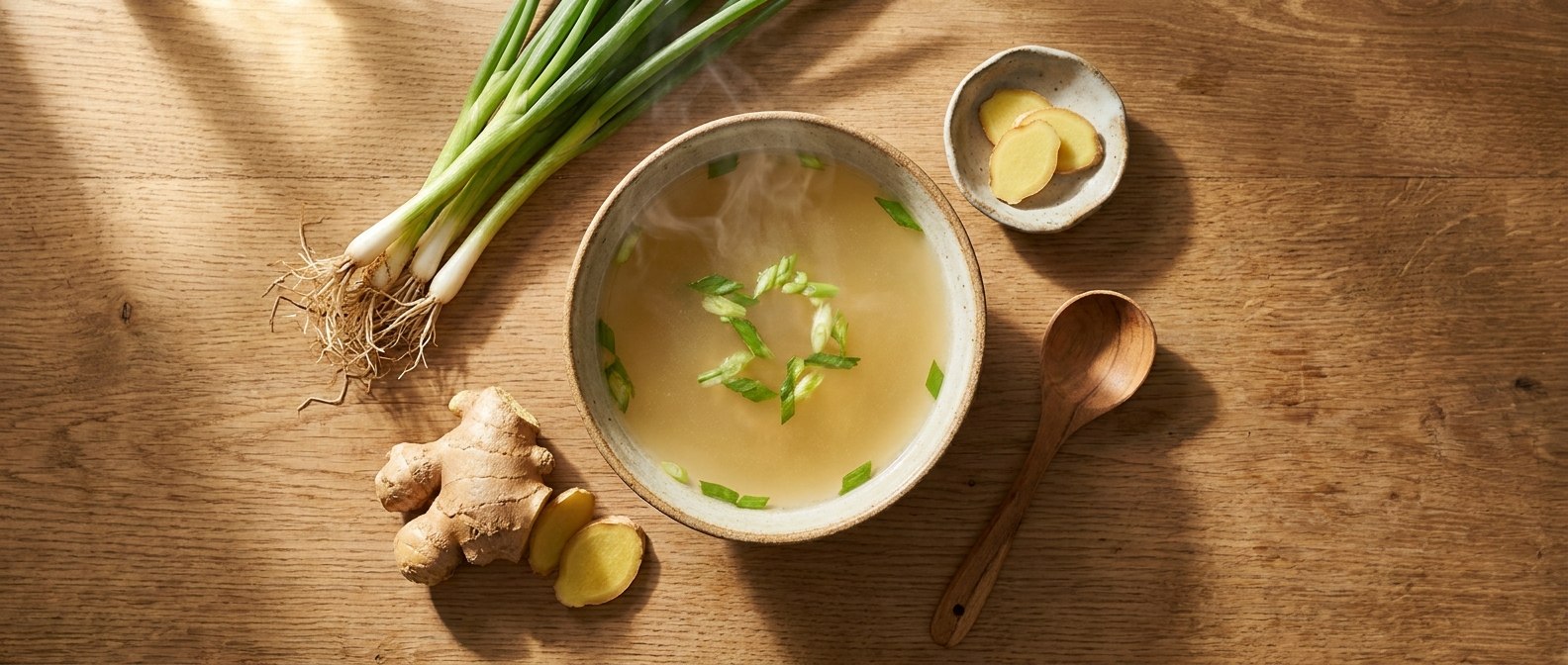
Chinese medicine has a very specific answer to this moment. Not a cabinet full of supplements. Not a trip to the chemist. Just three ingredients from your kitchen, a pot, fifteen minutes, and a blanket.
This soup has been used in Chinese medicine for centuries. It goes by the name Cong Bai Sheng Jiang Tang (葱白生姜汤), scallion white and fresh ginger decoction. It is not complicated. That is the point.
Quick answer
Cong Bai Sheng Jiang Tang is a Chinese medicine decoction made with scallion whites, fresh ginger, and broth. Simmer for 15 minutes, drink hot, then bundle up and rest. It is traditionally used to release wind-cold from the exterior of the body in the first 24 to 48 hours of a cold. Timing matters, act at the first sign of symptoms, before the pattern has a chance to develop further.
Is This Soup Right for What You Have?
This is the part most recipes skip. They give you the ingredients and send you on your way. But this soup only works for one type of cold. Use it for the wrong pattern and it will not help.
In Chinese medicine, the common cold typically falls into two main types: wind-cold and wind-heat. This soup is for wind-cold.
Here is how to tell which one you have.
Wind-cold looks like this:
- More chills than fever, you feel cold and cannot get warm
- Body aches, stiff neck and shoulders
- Clear or white nasal mucus
- No particular thirst
- First day or two of feeling off
Wind-heat looks like this:
- Fever more prominent than chills
- Sore, red throat
- Yellow or green mucus
- Thirsty, possibly sweating already
If your symptoms match wind-heat, this soup is the wrong prescription. Ginger and scallion are warming and pungent, excellent for driving out cold, not helpful when there is already heat present. If you are not sure which one you have, talk to your practitioner before reaching for the pot.
The Timing Window
There is a window with this remedy. It is short.
Chinese medicine describes wind-cold as a pathogen sitting on the exterior of the body, in the muscles, the skin, the surface layer. In the first day or two, it has not moved deeper. That is when this soup works. You are giving your body heat and momentum to push the pathogen back out through the pores.
Wait until day three or four, with symptoms worsening and a proper fever developing, and this soup is not enough. At that stage the pattern has changed and the treatment needs to change with it.
Act early. That is the whole game.
What’s in the Soup
Scallion White (葱白, Cong Bai)
Scallion is the one ingredient most people overlook as medicine. In Chinese medicine it is the primary herb in this formula. The white root portion is what matters, not the green tops. Pungent and warming, it is classified as an exterior-releasing herb. It opens the pores, encourages a light sweat, and helps the body push the pathogen toward the surface.
You want the whites only. The green parts are better in a stir-fry.
Fresh Ginger (生姜, Sheng Jiang)
Fresh ginger, not dried and not powdered. In Chinese medicine these are treated as different medicines. Fresh ginger releases the exterior and disperses cold. Dried ginger warms the interior, useful for digestive cold, not the same effect here. For this soup, fresh is what you need.
It is at any Asian grocery, most supermarkets, or you can keep a knob in the freezer and grate it straight from frozen when you need it.
Broth
Chicken broth is the traditional base, warming, nourishing, and easy to digest when you are under the weather. Store-bought low-sodium chicken broth is fine. There is no need to make it from scratch.
If you would like to upgrade to a medicinal bone broth made with TCM herbs, the recipe is here: Chinese Herbal Bone Broth. The same logic applies, it just adds more.
Vegetable broth works too. In a pinch, plain water will do.
How to Make It
Servings: 1 (make a fresh batch each time, not a big pot for later)
Prep: 5 minutes
Cook: 15-20 minutes
Tools: Small saucepan, mug or bowl
Ingredients
- 2 to 3 cups low-sodium chicken or vegetable broth (or water)
- 3 to 4 scallions, white and pale green parts only, roughly chopped
- 5 to 6 slices fresh ginger, thumb-sized piece (no need to peel)
- 1 to 2 garlic cloves, sliced (optional)
- Pinch of salt to taste
Method
- Bring the broth to a gentle boil in a small saucepan.
- Add the ginger slices and garlic if using. Reduce to a low simmer and let them infuse for 10 minutes.
- Add the scallions. Simmer for another 5 minutes. The whites should soften slightly.
- Taste and add a pinch of salt if needed.
- Pour into a mug or bowl through a strainer. Drink it hot.
- Get warm. Put on an extra layer, get into bed, pull up a blanket. You want to encourage a light sweat. Rest for at least 30 minutes.
That is it.
Make It Easier / Faster
- Use store-bought low-sodium chicken broth and skip any broth-making, it is already at the right base
- Keep a knob of ginger in the freezer so you always have it on hand. Grate straight from frozen into the pot.
- Pre-chop a batch of scallion whites and keep them in a container in the fridge during cold season
- If you are too exhausted to stand at the stove, a rice cooker on the soup setting works fine
How Often to Have It
Drink it at the first sign of symptoms. Then again two to three times through the day, each time made fresh and drunk hot. The goal is to maintain warmth and momentum in the body, so cold soup sitting in a thermos is not the same thing.
If symptoms have not shifted after two days, or if they worsen at any point, stop and see a practitioner or your GP.
Frequently Asked Questions
What if I’m already a few days into the cold?
If you are past day two and things are progressing, more fever, mucus turning yellow, throat getting worse, the pattern has likely changed. This soup will not do much at that stage. It is worth seeing your practitioner to work out where you are now and what will actually help.
Can I use dried or powdered ginger instead of fresh?
Dried ginger is a different herb in Chinese medicine. It warms the interior rather than releasing the exterior. Not the same effect. Fresh ginger is worth tracking down, it is at most supermarkets and will keep for weeks in the fridge or indefinitely in the freezer.
Is this safe during pregnancy?
Ginger in food quantities is generally well tolerated, but if you are pregnant and unwell, please check with your GP or midwife before self-treating with anything, including this soup. Do not guess.
What about children?
For older children this is gentle enough in smaller quantities, with ginger reduced to one or two slices. For young children or babies, check with your paediatrician first.
What if it doesn’t seem to help?
Either the pattern is not wind-cold, or the timing window has passed. Either way, keep treating it as a self-care measure and see someone if you are not improving. Do not keep making the same soup and expecting different results.
When to Get Some Help
This soup is for mild, early-stage wind-cold. It is not a replacement for medical care when that is what you need.
See your GP if you have:
- A fever above 38.5°C that is not coming down
- Symptoms lasting longer than 7 to 10 days, or getting worse rather than better
- Shortness of breath, chest tightness or difficulty breathing
- Significant ear pain or facial pressure
- A sore throat that makes swallowing difficult
- Any underlying respiratory or immune condition that makes respiratory illness complicated
If you want Chinese medicine support alongside your regular care, book a consultation here and we can work out what your pattern actually is and what to do about it.
And if you want to understand how Chinese medicine thinks about illness more broadly, why it looks at cold and flu the way it does, and what self-care options exist for each pattern, that is exactly the kind of thing we cover in Before the Needles.